
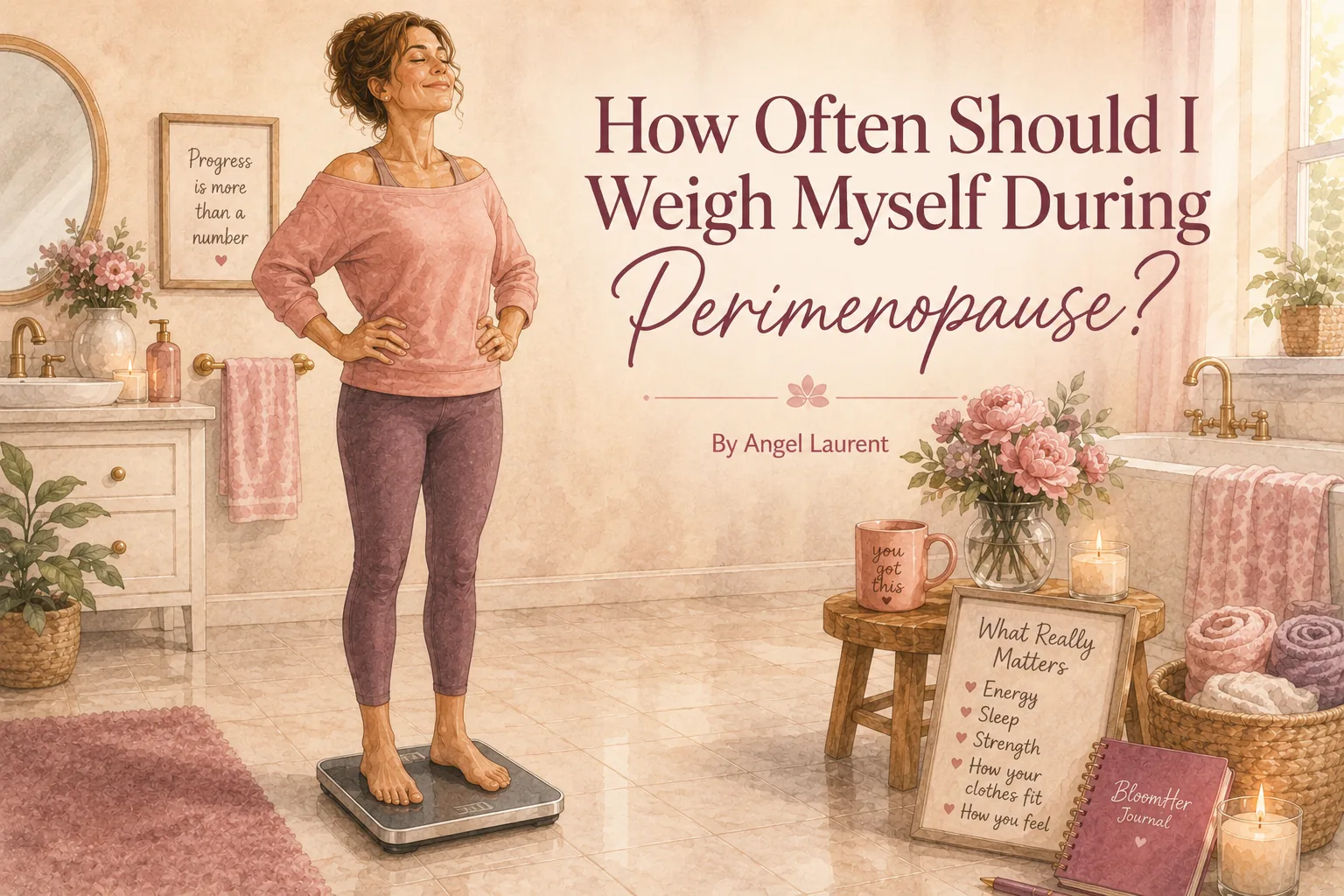
Let us talk about that cold, hard square on your bathroom floor: the scale. If stepping onto it in the morning dictates whether you have a good day or a bad day, it is time to rewrite your relationship with that number. During perimenopause, relying on the scale as your primary measure of success is a recipe for heartbreak.
The illusion of hormonal fluctuations
During perimenopause, your estrogen levels can swing wildly from day to day. These dramatic hormonal shifts directly impact water retention, digestion, and inflammation.
The reality of the scale: it is entirely common for a woman in perimenopause to fluctuate by 3 to 5 pounds within a single 48-hour period. This is not fat gain or fat loss; it is simply fluid shifts, bowel changes, and cortisol responses.
If you weigh yourself every single day, you are catching these erratic waves. Seeing an unexpected spike can induce immediate stress, which drives up cortisol, increases emotional eating, and makes you want to throw in the towel. And as I explained in how stress affects weight loss, that cortisol spike is not just a bad mood. It is a fat-storage signal. In other words, the daily weigh-in can literally work against the very goal it is supposed to measure.
A healthier approach to tracking
You do not have to abandon data. You just have to stop drowning in the noise of a single day. Pick the approach that fits your temperament.
- Option A, the weekly average: If you prefer data, weigh yourself just once or twice a week on designated days, first thing in the morning, and look at the overall monthly trend rather than individual days. The trend line is the truth. Any single dot on it is just weather.
- Option B, the 30-day check-in: Ditch the scale entirely for weeks at a time and only step on it once a month. For many women, this is the single most freeing change they make all year.
- The ultimate metric, how your clothes fit: Because muscle is much denser than fat, your body composition can change dramatically while the scale stays exactly the same. If your waist is narrowing, your energy is soaring, and your clothes feel loose, you are burning fat, no matter what the scale says.
That last point is the one I most want you to hold onto, because it connects to the measuring stick I gave you in why am I always tired: on the right plan, your energy improves before the scale moves. If you are only watching the scale, you can miss weeks of real, beautiful progress happening in your waistband, your sleep, your mood, and your strength.
What we track instead, and why it works
This is exactly why the BloomHer membership app was built to track your foods, weight, moods, and sleep cycles together, not the weight alone. When you can see your energy climbing and your sleep deepening while the scale takes its slow, wavy time, you stop panicking at the daily number and start trusting the direction. Working practitioner-led through BloomHer, alongside your primary care doctor and our network provider, we read those trends together, and we use comprehensive lab testing read for optimal to confirm what is actually happening underneath a number that only measures gravity. Your method, ShapeUp as the foundation, Fire inside Radiance, Butter inside Full Bloom, is adjusted on the trend and the whole picture, never on one anxious morning.
Your worth is not a number, and your metabolic progress cannot be fully captured by a machine that only measures your relationship with gravity. Focus on how you feel, how you move, and how your clothes fit. Step off the scale, and you may finally be able to see how far you have already come.