
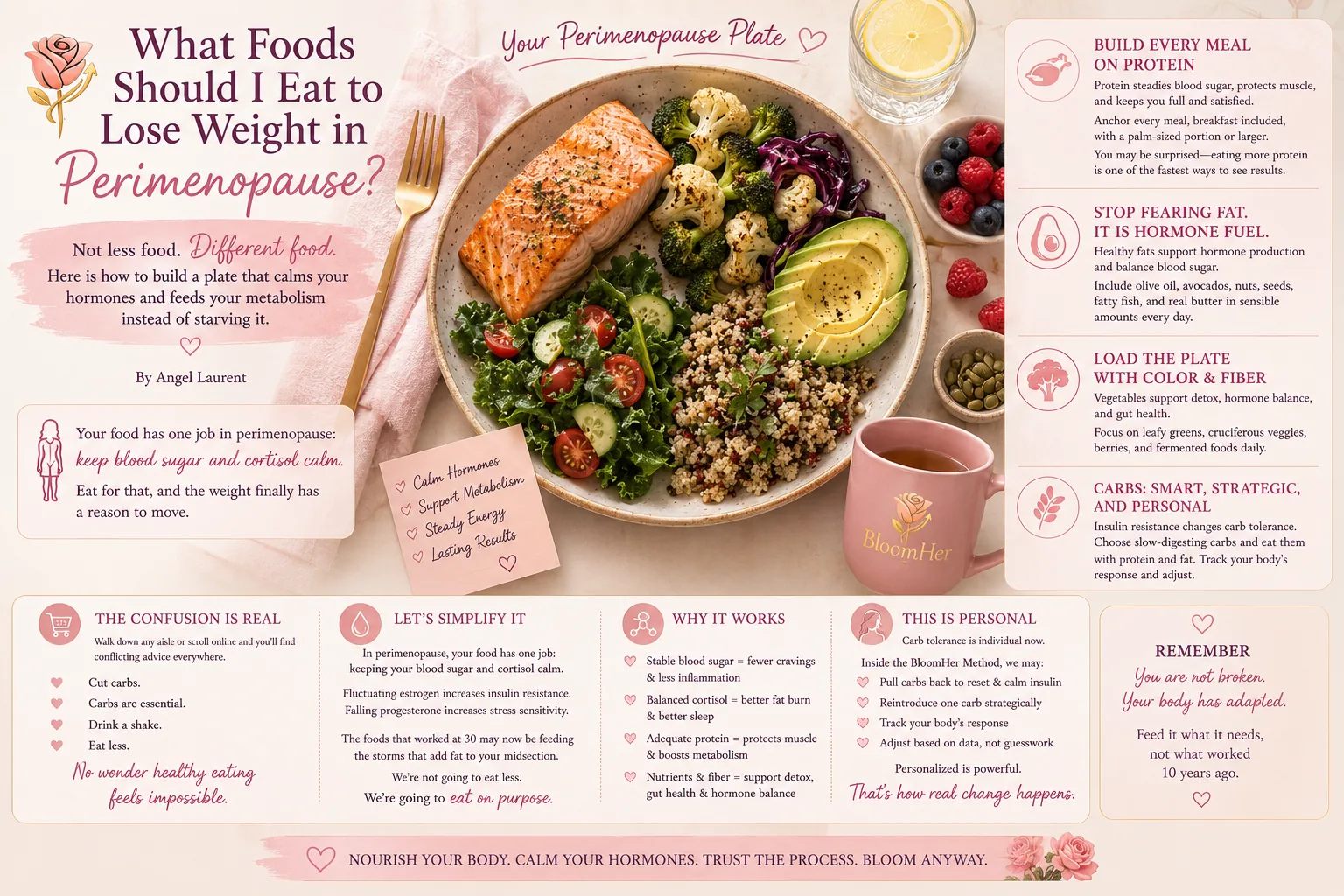
Walk down any grocery aisle or scroll for five minutes, and you will find someone telling you to cut carbs, someone telling you carbs are essential, someone selling you a shake, and someone insisting you simply eat less. No wonder the women who come to me say the same thing: "Healthy eating used to feel simple. Now it feels impossible."
Let me simplify it for you. In perimenopause, your food has one job above all others: keeping your blood sugar and your cortisol calm. Fluctuating estrogen has made your cells more resistant to insulin, and falling progesterone has made you more sensitive to stress. The foods that served you fine at 30 may now be feeding the exact storms that put fat on your midsection. So we are not going to eat less. We are going to eat on purpose.
Build every meal on protein
If you change only one thing after reading this, make it protein. Protein steadies blood sugar, protects the lean muscle that runs your metabolism, and switches off the scrambled hunger signals that leave you unsatisfied an hour after eating. Most women I meet are eating half of what their body needs in this season.
Anchor every single meal, breakfast included, with a serious portion of clean protein: eggs, wild-caught salmon and other fish, chicken and turkey, lean beef, Greek yogurt, cottage cheese. A palm-sized portion or larger at each meal is a simple starting rule. Women are often shocked that the first thing I do is ask them to eat more, and then shocked again when the scale finally moves.
Stop fearing fat. It is hormone fuel.
Your hormones are literally built from fat and cholesterol. Decades of low-fat dieting have left a generation of women trying to navigate perimenopause on empty raw materials. Healthy fats also slow digestion, which flattens the blood sugar spike of anything you eat alongside them.
Bring in olive oil and avocados, nuts and seeds, fatty fish, and yes, real butter in sensible amounts. Fat is not the enemy of a woman in perimenopause. Blood sugar chaos is.
Load the plate with color and fiber
Vegetables do quiet, powerful work in this season. Fiber slows glucose absorption, feeds the gut bacteria that help regulate your hormones, and helps your body clear used estrogen the way it is designed to. Cruciferous vegetables like broccoli, cauliflower, Brussels sprouts, and cabbage deserve special mention here, because they directly support healthy estrogen metabolism. Add leafy greens daily, berries for something sweet and antioxidant-rich, and fermented foods like plain kefir or sauerkraut for your gut.
The carbohydrate question, answered honestly
Here is where I differ from both camps. Carbs are not evil, and they are not a free-for-all. In perimenopause, insulin resistance means your carb tolerance has genuinely changed, and, more importantly, it is now individual. The carbohydrate that works beautifully for your metabolism may spike your best friend's, and hers may spike yours.
This is exactly how we work inside the BloomHer methods. Depending on the phase, we may pull carbohydrates back so your body can switch fuel sources and calm the insulin roller coaster, then strategically reintroduce a single carbohydrate, one selected specifically for your metabolism, and watch how your body responds. The moment the data says it is not working, we change the route. You saw this play out in my client's story in why the weight keeps coming back: guided carbohydrate strategy is one of the most powerful levers we have, and it only works when it is personal.
If you are choosing carbs on your own in the meantime, choose the slow ones: sweet potatoes, quinoa, oats, beans and lentils, and fruit, eaten with protein and fat rather than alone.
What to quietly crowd out
I do not build my clients' lives around forbidden lists, but three things fight you hardest in this season. Sugar and refined flour hit an insulin-resistant body harder than they used to. Alcohol disrupts the deep sleep where your best fat-burning and repair happen, and your tolerance for it hormonally is lower than it was. Ultra-processed foods are engineered to override the very fullness signals perimenopause has already scrambled. You do not need perfection with these. You need honesty about what they cost you now.
The mistake that undoes everything: eating too little
Please hear this. The worst thing you can do with this list is turn it into another 1,200-calorie punishment plan. Under-eating convinces your body the famine has arrived, and a body in famine mode slows your metabolism and guards its fat, exactly as I showed you with Sarah in losing weight during perimenopause. She gained weight running on 1,200 calories a day, and she started losing when we fed her properly. Nourish and satisfy is not a slogan at BloomHer. It is the mechanism.
The honest answer about "the perfect food list"
Everything above is true for almost every woman. But the plan that finally works for you will be built from your own data, not a blog post, mine or anyone else's. Your labs tell us your deficits. Your tracking in the BloomHer membership app, foods, weight, moods, and sleep cycles, tells us how your body is actually responding. And working practitioner-led through BloomHer, alongside your primary care doctor and our network provider, we match you to the right method, ShapeUp, Fire, or Butter, and modify it the moment your body adapts.
That is the real answer to "what should I eat." Start with the plate I gave you today. Then stop guessing, and let your own body write the rest of the list.