
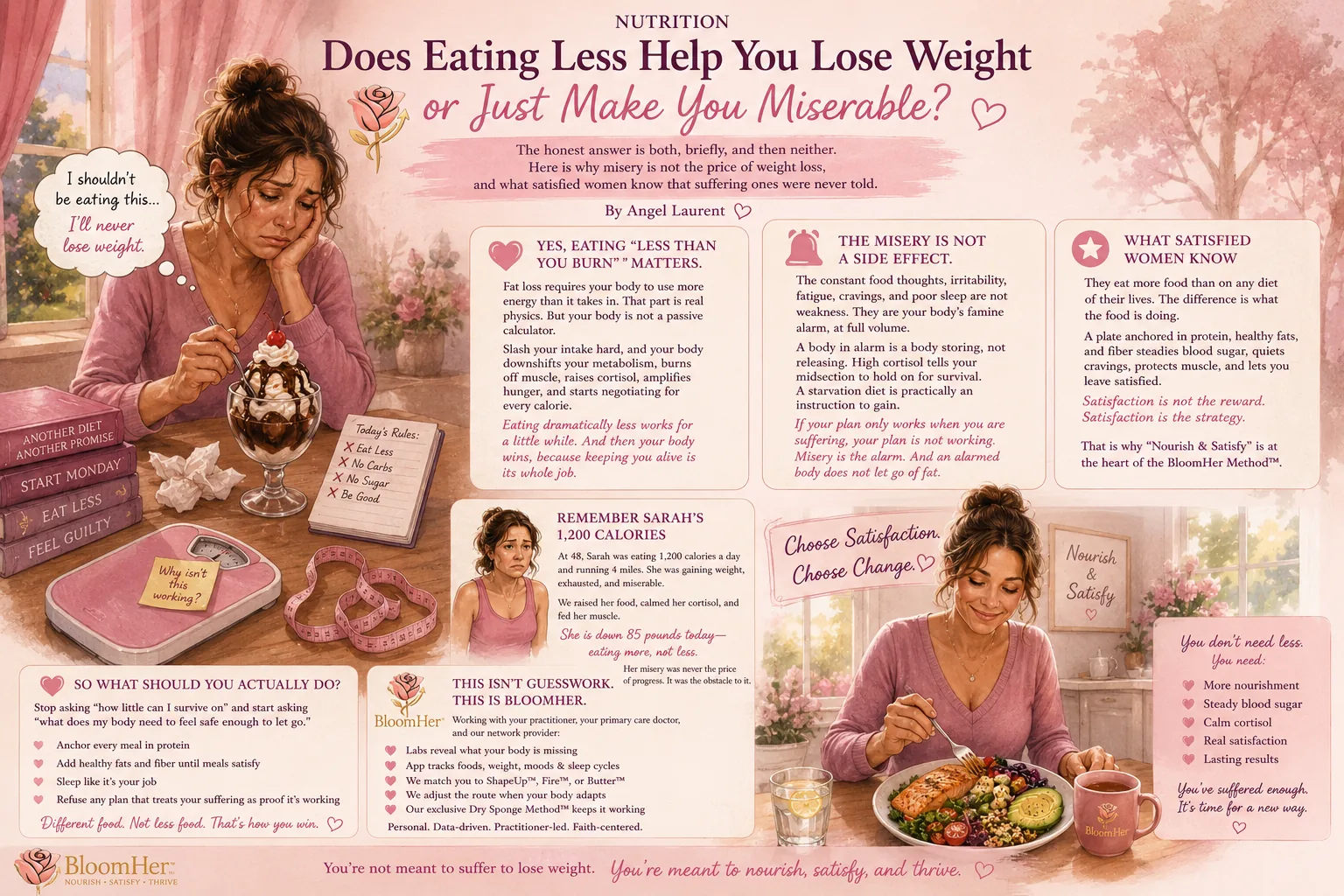
You know the feeling. Week one of the new diet, and you are hungry but hopeful. Week three, and you are thinking about food all day, snapping at people you love, and lying awake with your stomach growling, telling yourself this is what it takes.
So let me ask the question honestly, because almost nobody does: does eating less actually work, or does it just make you miserable?
The truthful answer is that it does both, briefly. And then, for most women past 40, it quietly stops doing the first one and keeps doing the second. Understanding why is the difference between your last diet and your last diet ever.
Yes, eating "less than you burn" matters. But that is not the whole sentence.
I will not insult you with fairy tales. Fat loss requires your body to use more energy than it takes in. That part is real physics. But here is the part the "just eat less" crowd leaves out: your body is not a passive calculator. It is a living system that responds to how that gap is created, and it treats a harsh gap as an emergency.
Slash your intake hard, the way most diets demand, and your body does not simply surrender its fat. It downshifts your metabolism, burns off precious muscle, raises cortisol, amplifies hunger hormones, and starts negotiating for every calorie. You have seen where that ends: the plateau, the rebound, the weight coming back with interest. I walked you through that whole survival mechanism in why the weight keeps coming back.
So eating dramatically less works the way holding your breath works. Yes, technically, for a little while. And then your body wins, because it always wins, because keeping you alive is its whole job.
The misery is not a side effect. It is the alarm going off.
Here is the reframe I need you to carry out of this article. That miserable feeling, the constant food thoughts, the irritability, the fatigue, the sleep that falls apart, the cravings that feel bigger than you are: that is not weakness, and it is not the toll you must pay. That is your body's famine alarm, at full volume, actively working against your goal.
A body in alarm is a body storing, not releasing. High cortisol alone tells your midsection to hold on for survival, and for a woman in perimenopause, already more cortisol-sensitive because progesterone has fallen, a starvation diet is practically an instruction to gain.
What satisfied women know
Now flip it. The women in my practice who lose weight and keep it off are not white-knuckling anything. They are eating more food than they ate on any diet of their lives. The difference is what the food is doing.
A plate anchored in clean protein, healthy fats, and fiber, the plate I built for you in what to eat in perimenopause, steadies blood sugar, quiets cravings at the source, protects the muscle that runs your metabolism, and lets you leave the table actually satisfied. When meals genuinely satisfy, the gentle energy gap that fat loss needs happens almost on its own, without triggering the alarm, because your body never gets the message that food is scarce.
That is the entire secret hiding in plain sight. Satisfaction is not the reward you earn after the weight loss. Satisfaction is the strategy that produces it. Nourish and satisfy is literally written into the BloomHer method, because it is the mechanism that makes results last.
Remember Sarah's 1,200 calories
If you need proof, remember Sarah from my perimenopause article. She came to me at 48 eating 1,200 calories a day and running four miles, and she was gaining weight, exhausted, and miserable. We raised her food, calmed her cortisol, fed her muscle, and the weight finally started moving. She is down 85 pounds today, and she got there eating more, not less. Her misery was never the price of progress. It was the obstacle to it.
So what should you actually do?
Stop asking "how little can I survive on" and start asking "what does my body need to feel safe enough to let go." Those are two different questions, and only one of them ends well.
Practically, that means anchoring every meal in protein, adding fats and fiber until meals genuinely hold you, sleeping like it is your job, and refusing any plan that treats your suffering as proof it is working. And when you are ready to stop guessing, we build the precise version: working practitioner-led through BloomHer, alongside your primary care doctor and our network provider, your labs tell us what your body is missing, the BloomHer membership app tracks your foods, weight, moods, and sleep cycles, and we match you to the right method, ShapeUp, Fire, or Butter, adjusting the route the moment your body adapts, the way our exclusive Dry Sponge Method is designed to do.
You have suffered enough for this goal. It was never the suffering that was going to get you there.