
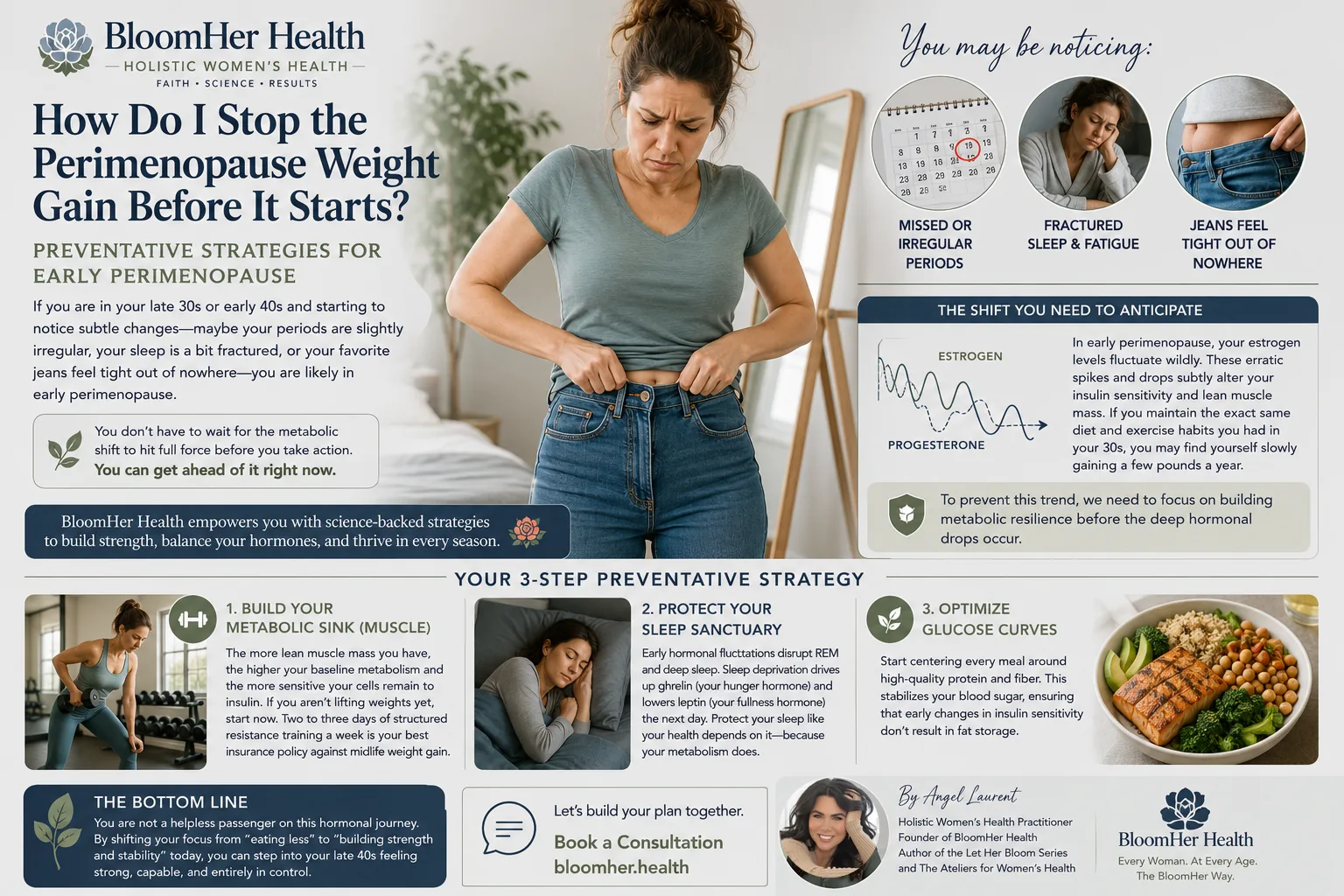
If you are in your late 30s or early 40s and starting to notice subtle changes, maybe your periods are slightly irregular, your sleep is a bit fractured, or your favorite jeans feel tight out of nowhere, you are likely in early perimenopause.
And here is the sentence I wish someone had said to every woman at 38: you do not have to wait for the metabolic shift to hit full force before you take action. You can get ahead of it right now. Almost everything I write in this series is for the woman already deep in the storm. This article is for the woman who can still see it coming, because prevention is the one advantage this transition offers, and almost nobody tells you to take it.
The shift you need to anticipate
In early perimenopause, your estrogen levels have not completely flatlined; instead, they are beginning to fluctuate wildly. These erratic spikes and drops begin to subtly alter your insulin sensitivity and lean muscle mass. If you maintain the exact same diet and exercise habits you had in your 30s, you may find yourself slowly gaining a few pounds a year.
A few pounds a year sounds small until you do the math across a decade. That quiet creep is exactly the pattern I unpacked in how much weight to expect in perimenopause, and it is far easier to prevent than to reverse. To prevent this trend, we need to focus on building metabolic resilience before the deep hormonal drops occur.
Your 3-step preventative strategy
1. Build your metabolic sink (muscle)
The more lean muscle mass you have, the higher your baseline metabolism and the more sensitive your cells remain to insulin. If you are not lifting weights yet, start now. Two to three days of structured resistance training a week is your best insurance policy against midlife weight gain. Muscle is where the glucose from your meals goes to be used instead of stored, which is why I call it your metabolic sink: the bigger the sink, the more your body can handle without a spill. If you need the case made in full, it is waiting in cardio versus strength, and the no-gym plan proves your living room is enough.
2. Protect your sleep sanctuary
Early hormonal fluctuations disrupt REM and deep sleep, often years before the more famous symptoms arrive. Sleep deprivation drives up ghrelin, your hunger hormone, and lowers leptin, your fullness hormone, the very next day. Protect your sleep like your health depends on it, because your metabolism does. A real wind-down, a consistent bedtime, morning light, and a hard afternoon caffeine cutoff cost you nothing now and pay you back for twenty years. The full mechanics are in the sleep article.
3. Optimize glucose curves
Start centering every meal around high-quality protein and fiber. This stabilizes your blood sugar, ensuring that early changes in insulin sensitivity do not result in fat storage. The plate is simple and it never goes out of date: protein first, as I laid out in the protein article, fiber and healthy fat alongside, refined flour and sugar as rare guests instead of roommates. Boring blood sugar in your late 30s is the quiet foundation of an easy metabolism in your 50s.
The bottom line
You are not a helpless passenger on this hormonal journey. By shifting your focus from "eating less" to "building strength and stability" today, you can step into your late 40s feeling strong, capable, and entirely in control.
And if you want to know exactly where your body stands right now, that is precisely what we do first. Comprehensive lab testing read for optimal, not merely normal, gives us your true starting line while there is still maximum room to act. Working practitioner-led through BloomHer, alongside your primary care doctor and our network provider, we build your prevention plan on your data, track your foods, weight, moods, and sleep cycles in the BloomHer membership app, and if deeper support is ever needed, your method is ready: ShapeUp as the foundation, Fire inside Radiance, Butter inside Full Bloom. I also walk through every age and era of a woman's health, including this one, in my book, Let Her Bloom in Health, because the woman who understands the road ahead never has to be surprised by it.
The women who thrive through this transition are almost never the ones who fought hardest in the middle of it. They are the ones who started before it started. Be her.