
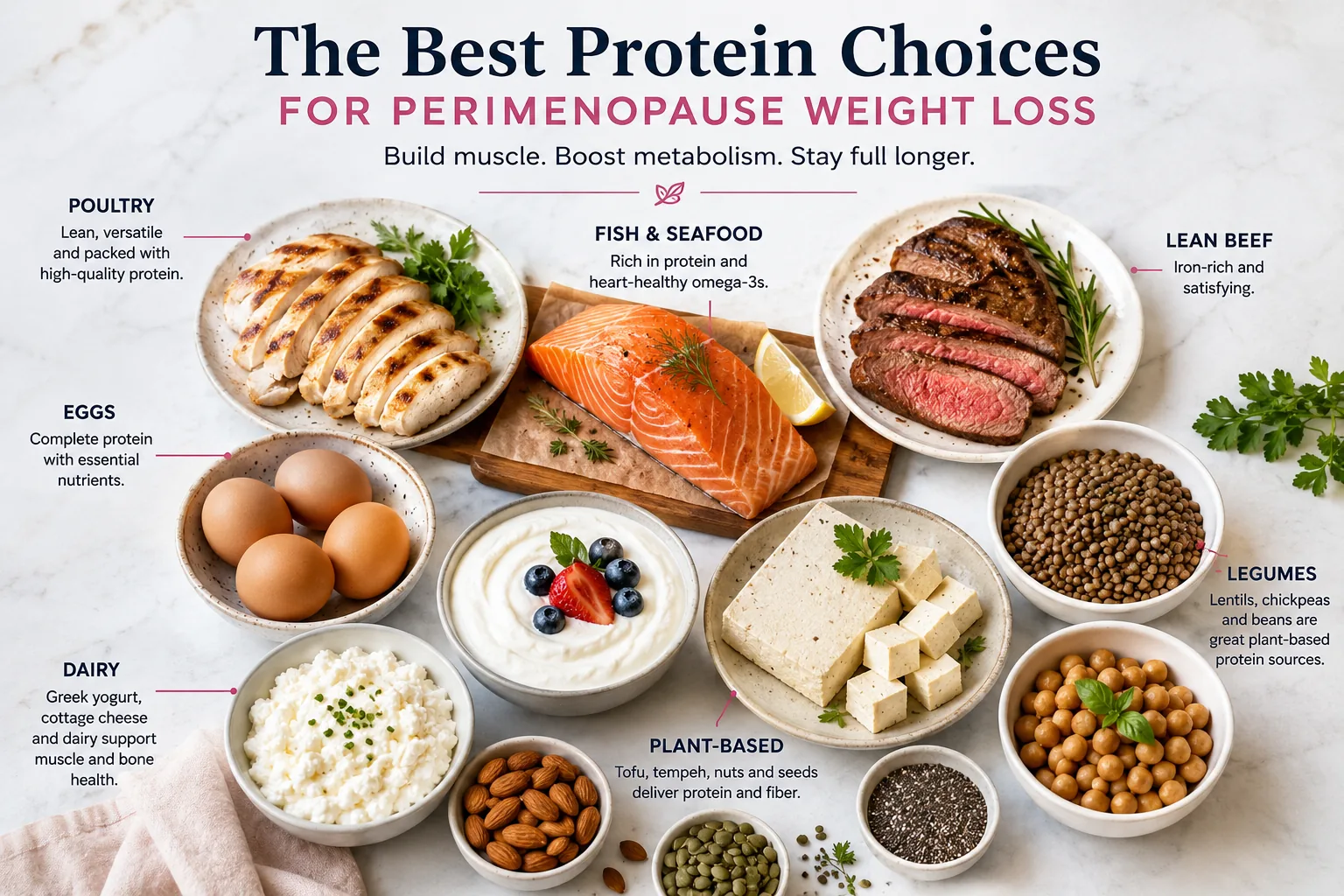
If I could change exactly one thing about how midlife women eat, before we ever discussed carbs, calories, fasting windows, or anything else with a hashtag, it would be this: I would double most women's protein. Because when I review the food logs of new clients, women who are certain they are "eating pretty healthy," the single most consistent finding is a protein intake that would barely maintain the body of a much smaller, much younger woman.
And in perimenopause, that quiet shortfall becomes expensive. Here is the part nobody put on a poster: your protein needs went up at the exact moment your hormones went down.
Why this season raised your protein bill
Estrogen was doing more for your muscle than you were ever told. It supported the signaling that turns the protein you eat into muscle you keep. As estrogen declines, your body develops what researchers call anabolic resistance: the same twenty grams of protein that maintained your muscle at 30 produces a weaker building response at 48. Your body still hears the signal. It just needs the signal louder.
At the same time, muscle itself is quietly leaving, a slide that accelerates through this transition, and as I showed you in why your metabolism slowed, muscle is the engine that decides your burn rate at rest. Underfeed protein while dieting and the weight you lose comes disproportionately from that engine. The scale applauds while your metabolism shrinks, which is precisely how women diet themselves into an easier-gaining body, the trap from why the weight keeps coming back.
So in this season, protein is not a macro. It is the material your results are built from: it defends the muscle, it quiets ghrelin better than any other food, as you saw in the satiety article, and it even costs more energy to digest than carbs or fat, a small metabolic bonus paid on every meal.
The numbers, in plain English
The official minimum you have heard, 0.8 grams per kilogram of body weight, was set to prevent deficiency, not to protect a midlife woman losing weight. Treat it as the floor, never the goal.
For women in this season who are actively losing weight and strength training, the research and my practice agree on a far more useful range: roughly 0.7 to 1 gram of protein per pound of your goal body weight, per day. A woman whose healthy target is 150 pounds is aiming for somewhere around 105 to 150 grams daily. Where you land in that range is personal, and this is exactly the kind of dial we set individually inside your program based on your labs, your training, and how your body responds.
If that number just made your eyes widen, good. Now you understand why you have been hungry, losing muscle, and stalling: most women I meet are living at a third of it.
Distribution: the part almost everyone misses
Here is the detail that separates women who transform from women who merely try: it is not just how much protein, it is how it is spread. Your body builds best when protein arrives in substantial doses throughout the day, roughly 25 to 40 grams per meal, rather than a token breakfast, a light lunch, and a protein pile at dinner.
And the meal that matters most is the one women shortchange worst: breakfast. Coffee and a granola bar is a dessert wearing a health costume. A breakfast built on 30 or more grams of protein, eggs with cottage cheese, Greek yogurt with hemp seeds, a real protein smoothie, changes the entire day downstream: steadier blood sugar, quieter cravings, and satiety that lasts until lunch instead of 10 a.m., the effect I keep pointing to in what to eat in perimenopause.
What 30 grams actually looks like
Numbers become real on a plate, so: a palm-and-a-half of chicken, salmon, or lean beef. About a cup of Greek yogurt with a spoonful of hemp seeds. Four eggs, or three eggs with a side of cottage cheese. A properly built protein shake. Lentils and beans contribute too, though plant proteins generally need bigger portions and smart pairing to deliver the same dose, which matters if you eat mostly plants: it is fully doable, it simply takes intention.
Quality counts as well. Whole food sources first, because they arrive packaged with the nutrients this season runs on. Powders and shakes are supporting cast, wonderful for the busy mornings we solved in the busy-life article, but they should assist your plate, not become it.
Two myths to retire on your way out
"All that protein will make me bulky." It will not, and I say that with love and slight exasperation. Building visible muscle mass takes years of deliberate heavy training, and midlife hormones make bulk harder, not easier. What protein plus strength work builds is the toned, strong shape women describe wanting, plus the metabolism that maintains it.
"High protein is hard on your body." For a healthy woman, intakes in the range above are well studied and well tolerated. Where kidneys or other conditions are in the picture, that is a conversation for your medical providers, and it is exactly why every BloomHer plan begins with comprehensive lab testing read for optimal and runs alongside your primary care doctor and our network provider, never around them.
Inside your program, your protein target is not a poster on a wall. It is set for your body, tracked with your foods, weight, moods, and sleep cycles in the BloomHer membership app, and adjusted through your method, ShapeUp as the foundation, Fire inside Radiance, Butter inside Full Bloom, the moment your data says your body has changed.
So before you cut another food group or shrink another portion, try the unglamorous move that outperforms almost everything: double your protein, spread it across the day, and give your body the lumber. Then watch what it builds.