
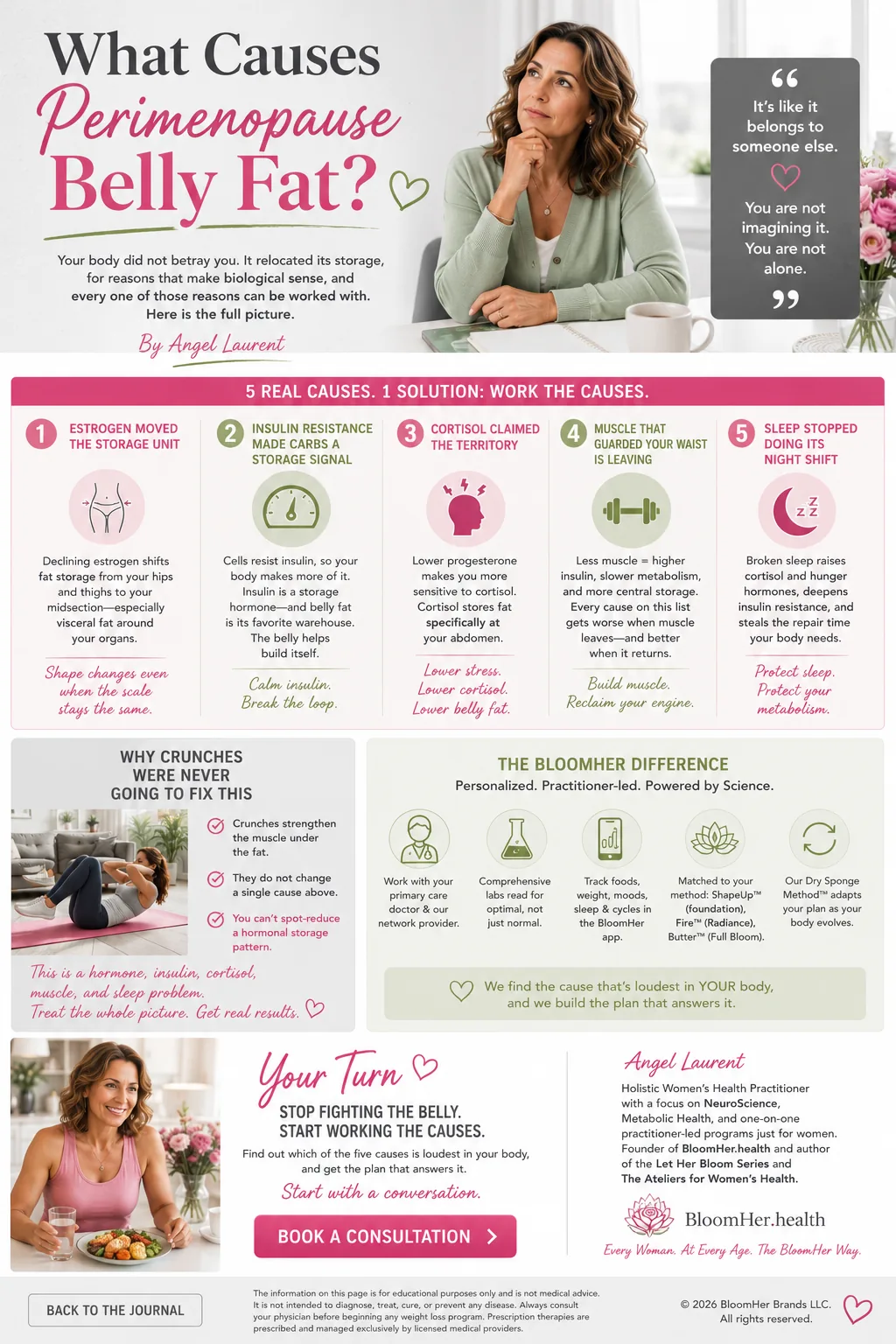
Of everything perimenopause does to a woman's body, this may be the one that feels the most personal. Your legs look the same. Your arms look the same. But there is a belly now, one that was simply never there before, and it does not respond to anything that used to work.
Women describe it to me almost identically every time: "It's like it belongs to someone else." So let me tell you exactly where it came from, because this is not random, it is not your discipline, and it is certainly not a mystery. Perimenopause belly fat has five specific causes, and they stack on top of each other.
Cause 1: Estrogen moved the storage unit
For your entire adult life, estrogen directed fat toward your hips and thighs, the classic female pattern. As estrogen declines and fluctuates through perimenopause, that instruction fades, and your body begins storing the way male bodies do: centrally, at the midsection, and more of it as visceral fat, the deeper kind that sits around your organs rather than under your skin.
This is why your shape can change even when your weight barely moves, the composition shift I described in how much gain to expect. The fat did not just grow. It relocated.
Cause 2: Insulin resistance made carbs a storage signal
Fluctuating estrogen also makes your cells more resistant to insulin. When cells resist insulin, your body pumps out more of it, and here is the cruel loop: insulin is a storage hormone, and visceral belly fat is its favorite warehouse. The same meals you ate at 35 now produce bigger insulin responses, and those responses now point at your waist.
Worse, visceral fat is not passive. It is metabolically active tissue that itself worsens insulin resistance, which drives more central storage. The belly literally helps build itself. This is why the plate strategy in what to eat in perimenopause is not about calories, it is about calming the insulin signal that feeds this loop.
Cause 3: Cortisol claimed the territory
Progesterone, your natural calming hormone, falls early in the transition, leaving you more sensitive to cortisol than you have ever been, right in the most demanding decade of your life. And cortisol has a signature move: it directs fat storage specifically to the abdomen, your body's survival stockpile, closest to the organs that would need fuel in a crisis.
Chronic stress, thin sleep, and, yes, the punishing daily cardio and starvation diets women use to fight the belly, all raise cortisol. Which means the standard approach to belly fat is often feeding it, exactly the trap I unpacked in my article on eating less.
Cause 4: The muscle that guarded your waist is leaving
While those three hormones point fat at your middle, the tissue that used to burn it off is declining. Muscle is your metabolic engine and your best insulin sensitizer, and as I showed you in why your metabolism slowed, women lose it steadily from their thirties onward unless they actively rebuild it. Less muscle means less glucose pulled from your blood, higher insulin, and more central storage. Every cause on this list gets worse when muscle leaves, and better when it returns.
Cause 5: Sleep stopped doing its night shift
Perimenopause fragments sleep, through night sweats, 3 a.m. cortisol surges, and racing minds. Broken sleep raises next-day cortisol and hunger hormones, deepens insulin resistance, and steals the deep-sleep window where your body does its best repair and fat metabolism. One bad night makes you crave. Years of them help build a belly.
Why crunches were never going to fix this
Now you can see why no amount of ab work touches it. Crunches strengthen the muscle underneath the fat, but they do not change a single one of the five causes above. You cannot spot-reduce a hormonal storage pattern. The belly is not an abs problem. It is an estrogen, insulin, cortisol, muscle, and sleep problem, and it responds beautifully when you treat it as one.
That means the plate that calms insulin, the strength training that rebuilds your engine, the walking and wind-down that lower cortisol, and the sleep repair that lets it all work. And because these five causes show up in a different mix in every woman, it starts with knowing your mix: comprehensive lab testing read for optimal, working practitioner-led through BloomHer alongside your primary care doctor and our network provider. Your foods, weight, moods, and sleep cycles tracked in the BloomHer membership app tell us which cause is loudest in your body, and our methods, ShapeUp as the foundation, Fire inside Radiance, and Butter inside Full Bloom, are matched and adjusted from there, guided by our exclusive Dry Sponge Method.
The belly that "belongs to someone else" was built by a handful of specific, named, workable causes. Work the causes, and it stops being permanent. I watch it happen every week, and the women it happens to are not more disciplined than you. They just finally knew what they were actually fighting.