Journal · Menopause
MenopauseAdvanced Menopause Care: Beyond Hot Flashes
By Angel Laurent · June 2026 · 10 min read
© BloomHer Health 2026 · All Rights Reserved
Menopause isn't simply the end of your menstrual cycle. It is one of the most significant neurological and metabolic transitions of a woman's lifetime.
Introduction
Why It Feels Like Your Brain and Metabolism Changed Overnight at 45
One day you're effortlessly juggling work, family, appointments, and conversations.
The next...
You walk into a room and forget why you're there.
Words disappear mid-sentence.
The weight you've never struggled with suddenly settles around your waist.
Your motivation disappears.
Sleep no longer restores you.
Many women begin wondering:
"Is this early Alzheimer's?"
"Am I just getting older?"
"Why doesn't my body feel like mine anymore?"
The truth is both reassuring and empowering.
For decades menopause was treated almost exclusively as a hot flash disorder.
Today's science tells a very different story.
The 2025-2026 discussions and consensus updates presented through The Menopause Society emphasize menopause as a whole-body neuro-metabolic transition, affecting the brain, muscles, metabolism, cardiovascular system, immune system, bones, and emotional regulation, not simply reproductive hormones.
At BloomHer, we call this The Great Midlife Reset.
Understanding what's happening biologically changes everything.
The Brain on Menopause
Why Brain Fog Is Real, and Usually Not Permanent
One of the biggest misconceptions about menopause is that brain fog means your brain is failing.
It isn't.
It's adapting.
Estrogen plays a remarkable role inside the brain.
It supports:
- •Glucose metabolism
- •Synaptic communication
- •Memory formation
- •Executive function
- •Learning
- •Mood regulation
- •Neuroplasticity
- •Cerebral blood flow
During perimenopause, estradiol levels fluctuate dramatically before eventually declining.
Those fluctuations temporarily reduce the brain's ability to efficiently use glucose as its preferred fuel.
Imagine putting premium gasoline into your car for decades.
Suddenly the fuel line becomes inconsistent.
The engine still works, but not nearly as smoothly.
Researchers now describe menopause as creating temporary changes in brain energy metabolism, particularly in regions responsible for executive function, memory, attention, and processing speed. Brain imaging studies also demonstrate structural and metabolic changes during the menopause transition, with evidence that some adaptations may partially recover after menopause through neuroplastic processes.
This explains why women commonly report:
- •Losing words mid-sentence
- •Difficulty multitasking
- •Forgetting appointments
- •Losing focus
- •Reduced mental stamina
- •Slower processing speed
This does not mean dementia.
In most healthy women, these cognitive changes are mild, fluctuate over time, and are considered part of the menopause transition rather than evidence of neurodegenerative disease.
Your brain is remodeling, not disappearing.
Beyond the Brain
Why Hormones Affect Your Entire Nervous System
Estrogen doesn't work only inside the ovaries.
It has receptors throughout the body, including:
- •Brain
- •Heart
- •Blood vessels
- •Muscles
- •Bones
- •Skin
- •Immune system
- •Gastrointestinal tract
As estrogen declines, these systems begin communicating differently.
Many women notice:
- •Increased anxiety
- •More stress sensitivity
- •Poor sleep
- •Mood swings
- •Reduced motivation
- •Hot flashes
- •Joint pain
- •Digestive changes
- •Heart palpitations
These symptoms often interact. Sleep disruption and vasomotor symptoms can amplify attention and memory problems, creating a cycle in which fatigue worsens cognitive performance.
The Visceral Fat Shift
Why Fat Suddenly Moves to Your Waist
Perhaps the most frustrating change women experience is abdominal weight gain.
It often happens despite eating the same foods.
This isn't simply about calories.
Estrogen helps regulate:
- •Insulin sensitivity
- •Fat storage
- •Appetite
- •Muscle maintenance
- •Inflammation
As estrogen declines:
- •Muscle mass gradually decreases.
- •Insulin resistance increases.
- •Energy expenditure falls.
- •Fat is preferentially stored around the abdomen.
This visceral fat is metabolically active.
Unlike fat stored in the hips and thighs during reproductive years, abdominal fat is associated with increased risks of:
- •Type 2 diabetes
- •Heart disease
- •Stroke
- •Fatty liver disease
- •Chronic inflammation
Emerging menopause guidance increasingly frames midlife as a critical opportunity for metabolic risk assessment and prevention rather than waiting for disease to develop.
Why Macros Matter More Than Calories
Many women respond by eating less.
Unfortunately, severe calorie restriction can worsen muscle loss.
Instead, women in midlife often benefit from emphasizing:
Higher Protein
Supports muscle preservation, recovery, and satiety.
High-Fiber Carbohydrates
Help stabilize glucose while supporting gut health.
Healthy Fats
Including olive oil, nuts, seeds, avocados, and omega-3 fatty acids to support cardiovascular and brain health.
Resistance Training
The most effective lifestyle strategy for preserving muscle, improving insulin sensitivity, and protecting bone density.
The goal shifts from becoming smaller to becoming stronger.
The BloomHer Protocol
Restoring the Neuro-Metabolic System
Step 1: Restore Sleep Architecture
Quality sleep is the foundation of hormone regulation.
Strategies include:
- •Consistent sleep schedule
- •Morning sunlight exposure
- •Limiting evening blue light
- •Cooling the sleep environment
- •Addressing sleep apnea when indicated
- •Cognitive Behavioral Therapy for Insomnia (CBT-I), which has evidence for improving sleep-related cognitive fatigue.
Step 2: Calm the Cortisol Response
Chronic stress compounds menopausal symptoms.
Support may include:
- •Breathwork
- •Prayer and meditation
- •Walking
- •Resistance exercise
- •Nature exposure
- •Adequate recovery
- •Healthy boundaries
Reducing nervous system overload allows metabolic healing to occur.
Step 3: Support Hormonal Health
For appropriate candidates under medical supervision, menopausal hormone therapy (MHT) remains the most effective treatment for vasomotor symptoms and may also support sleep, mood, and selected cognitive complaints when started near the menopause transition. Treatment decisions should be individualized based on benefits, risks, and personal health history.
Step 4: Consider Evidence-Based Herbal Options
Depending on symptoms and medical history, some women may discuss evidence-based botanical approaches with their healthcare professional, such as:
- •Black cohosh (mixed evidence for vasomotor symptoms)
- •Ashwagandha (stress support)
- •Rhodiola (fatigue)
- •Magnesium glycinate
- •Omega-3 fatty acids
- •Vitamin D (when indicated)
Natural does not always mean appropriate for every woman, so individualized guidance is important.
Step 5: Rebuild the Metabolic Foundation
BloomHer emphasizes:
- •Comprehensive laboratory assessment
- •Body composition evaluation
- •High-protein nutrition
- •Resistance training
- •Hormone evaluation
- •Stress reduction
- •Personalized supplementation
- •Long-term practitioner support
Because the goal isn't surviving menopause.
It's thriving beyond it.
The Future of Menopause Care
The old model focused almost entirely on treating hot flashes.
The new model recognizes menopause as a profound neuro-endocrine and metabolic transition.
When women understand:
- •Why brain fog happens,
- •Why metabolism changes,
- •Why fat redistributes,
- •Why sleep becomes fragile,
- •And how hormones interact with every organ system,
they stop blaming themselves.
Menopause is not the beginning of decline.
It is a new biological chapter, one that can be navigated with knowledge, evidence-based care, and a personalized plan.
At BloomHer, we believe that understanding your biology is the first step toward reclaiming your vitality.
Step Into Your Bloom
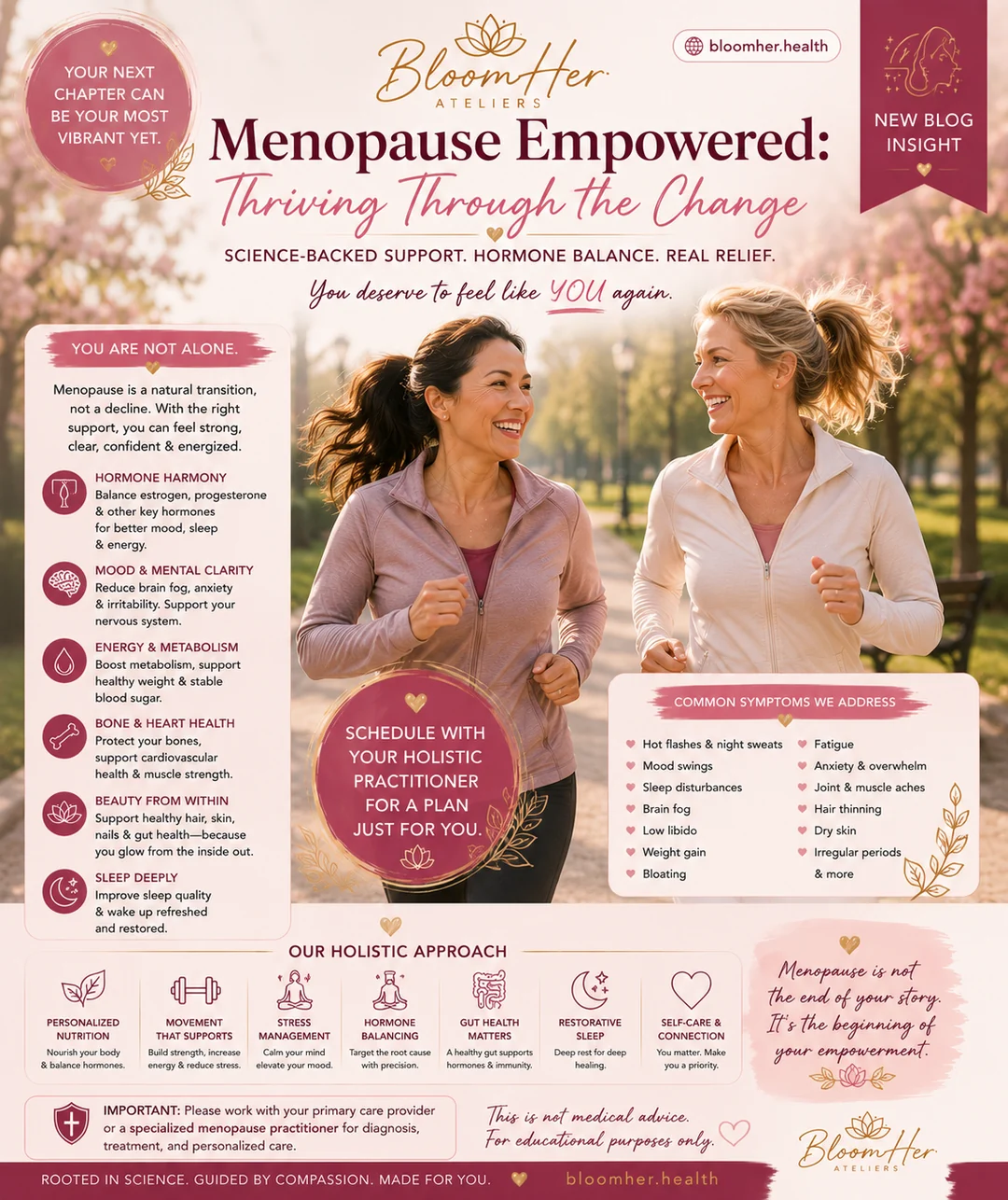
Menopause is not the end of your story, it is the beginning of your most vibrant chapter. To build a personalized, whole-body plan for your brain, metabolism, hormones, and sleep, book a private 1-on-1 BloomHer consultation with me today.
Research and References
Curated sources for further reading. Educational only, not medical advice.
- The Menopause Society. *How Menopause Restructures a Woman's Brain.* October 2025. Structural brain and energy metabolism changes during menopause, with implications for cognition and neuroplasticity.
- Kim Y, et al. *The 2025 Menopausal Hormone Therapy Guidelines.* Evidence-based recommendations on menopausal hormone therapy, cognition, metabolic health, and individualized care.
- International Menopause Society. *2026 Recommendations on Menopause Hormone Therapy.* Comprehensive guidance on hormone therapy, metabolic health, cognition, and cardiovascular risk.
- Gazerani P. *Menopause-related brain fog as a midlife window in women's brain aging.* *Frontiers in Human Neuroscience.* 2026. Review of menopause-related cognitive symptoms, brain energy metabolism, and digital assessment strategies.
- The Menopause Society Annual Meeting 2025. Research highlighting the shift toward whole-body optimization, metabolic health, and personalized menopause care.
- North American Neuropsychology Network. *Women's Health Month 2025: Cognition in Midlife Women.* Summary of evidence supporting exercise, CBT-I, stress management, and appropriate hormone therapy for cognitive symptoms during menopause.

About the Author
Angel Laurent, M.Ed.
Angel Laurent is a certified Holistic Health Practitioner, neuro-coach, and founder of BloomHer.health. With a Master's in Education and advanced training in neuroscience and metabolic health, she has dedicated her career to dismantling the "one-size-fits-all" approach to women's wellness, and is the creator of the Let Her Bloom Series and The Ateliers for Women's Health curriculum.
Through high-touch, one-on-one partnerships, her work centers on five pillars of modern women's wellness:
- •Neuro-Somatic Regulation: Chronic burnout, nervous system dysregulation, and the psychological "saboteurs" that stall well-being.
- •Metabolic Optimization: Restoring cellular energy, balancing blood sugar, and reversing insulin resistance behind stubborn weight gain and fatigue.
- •Endocrine & Hormone Synergy: Perimenopause, menopause, and hormonal transitions through evidence-based, holistic interventions.
- •Gut-Brain Axis Restoration: Healing the gut microbiome to enhance cognitive clarity, mood stability, and immune resilience.
- •Epigenetic Lifestyle Design: Bespoke lifestyle protocols to reclaim vitality, executive function, and physical longevity.
Have a question, or want to work with Angel? Reach her at hello@bloomher.health.
Every Woman. At Every Age. The BloomHer Way.
Don't miss a post
Get new insights from Angel Laurent delivered straight to your inbox.
No spam. Unsubscribe anytime.
