Journal · Hair Health
Hair HealthBreakthroughs in Female Hair Growth: The Regenerative Cellular Science Behind Fuller Hair
By Angel Laurent · June 2026 · 10 min read
© BloomHer Health 2026 · All Rights Reserved
Healthy hair doesn't begin at the scalp. It begins inside the cells that nourish every follicle.
Introduction
The Hidden Epidemic of Female Hair Loss
For many women, the first sign isn't a bald spot.
It's the extra strands in the shower.
The widening part.
The ponytail that suddenly feels thinner.
The brush that seems full of hair every morning.
Hair loss is deeply personal. It affects confidence, femininity, identity, and self-esteem. Yet it is one of the most overlooked symptoms in women's health.
Current research estimates that up to two-thirds of postmenopausal women experience some degree of hair thinning, and millions of younger women are affected by stress, hormonal shifts, nutritional deficiencies, autoimmune disease, thyroid disorders, polycystic ovary syndrome (PCOS), rapid weight loss, medications, and postpartum hormonal changes.
Unlike male pattern baldness, female hair loss is rarely caused by a single factor.
Instead, it is usually the result of several biological systems working together, or failing together.
At BloomHer, we don't ask:
"What shampoo are you using?"
We ask:
- •What are your hormones doing?
- •How are your nutrient stores?
- •Is your thyroid functioning optimally?
- •How much protein are you eating?
- •Have you lost weight rapidly?
- •Are you sleeping?
- •Is your gut absorbing nutrients?
- •What medications are you taking?
- •What does your ferritin level look like?
Hair is one of the body's first "luxuries" to be sacrificed when resources become limited.
If your body is struggling, your hair often tells the story first.
The Root Causes
Why Women's Hair Loss Is Different
Every hair follicle cycles through three stages:
Anagen
The active growth phase.
Catagen
A brief transition phase.
Telogen
The resting phase before shedding.
Normally, about 85-90% of scalp hairs remain in the growth phase.
When the body experiences physiological stress, more hairs can prematurely enter the telogen phase, resulting in increased shedding two to four months later, a condition known as telogen effluvium.
Hair loss is rarely caused by one problem alone.
The most common contributors include:
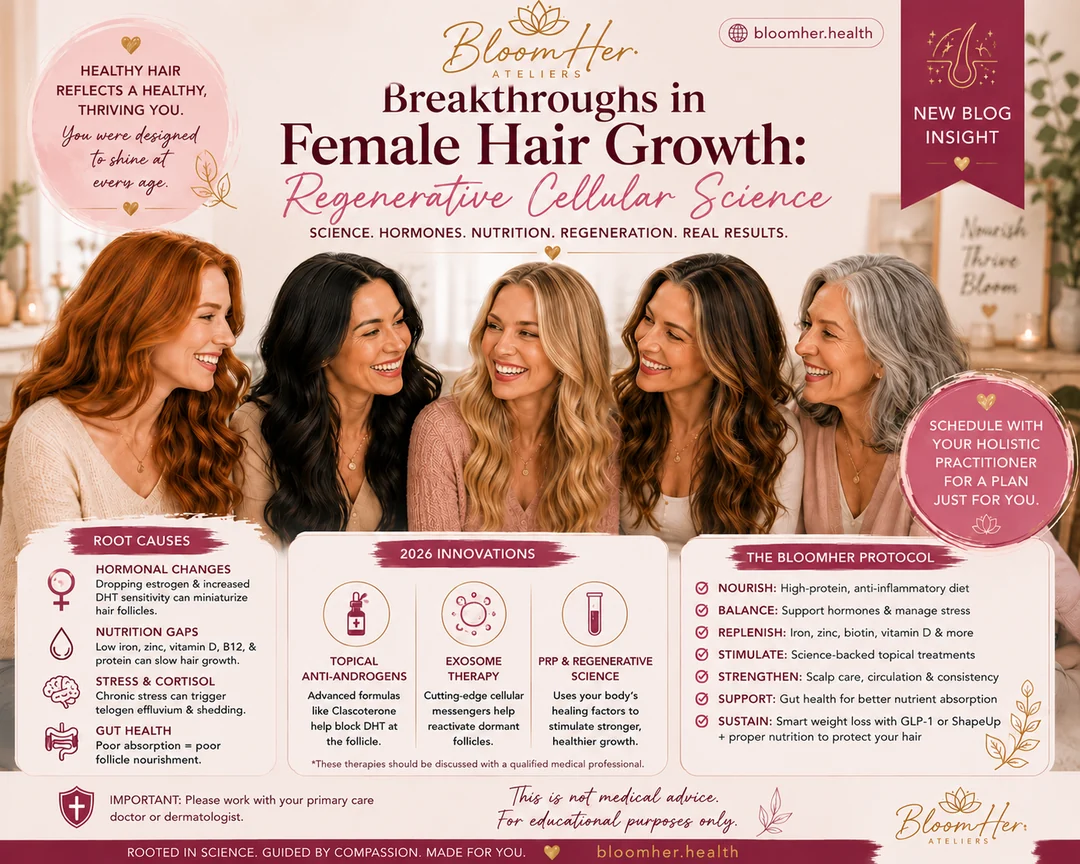
Estrogen Decline
Estrogen helps prolong the hair growth phase.
As estrogen decreases during perimenopause and menopause, hair may become finer and spend less time actively growing.
Increased Androgen Sensitivity
Women naturally produce small amounts of androgens such as testosterone.
Some hair follicles become increasingly sensitive to dihydrotestosterone (DHT), a potent androgen that can shorten the growth cycle and gradually miniaturize follicles.
Importantly, many women with female pattern hair loss have normal hormone levels. The issue is often increased follicular sensitivity rather than excess testosterone.
Iron Deficiency
One of the most overlooked causes of female hair loss is low ferritin, the body's iron storage protein.
Even when hemoglobin is normal, depleted iron stores may contribute to diffuse hair shedding.
Many dermatologists recommend evaluating ferritin in women with unexplained hair loss.
Thyroid Disease
Both hypothyroidism and hyperthyroidism can disrupt the hair cycle.
Chronic Stress
Elevated cortisol does not directly "kill" hair follicles, but prolonged physiological stress can trigger telogen effluvium and worsen inflammatory pathways.
Nutrient Deficiencies
Hair follicles require continuous access to:
- •Protein
- •Iron
- •Zinc
- •Vitamin D
- •Vitamin B12
- •Folate
- •Essential fatty acids
- •Selenium
- •Biotin (only when deficient)
The GLP-1 and ShapeUp Connection
Why Weight Loss Can Affect Hair
This is one of the most important conversations happening in women's health today.
Many women using GLP-1 medications or participating in very low-calorie weight-loss programs become alarmed when they notice increased hair shedding.
The medication itself is not thought to directly damage hair follicles.
Instead, several factors associated with rapid weight loss can contribute to temporary hair loss:
Reduced Calorie Intake
When calorie intake falls dramatically, the body prioritizes vital organs over hair production.
Lower Protein Intake
Hair is primarily made of keratin, a structural protein.
Without adequate dietary protein, follicles cannot maintain optimal growth.
Rapid Weight Loss
Rapid fat loss is a well-recognized trigger for telogen effluvium, regardless of whether it occurs after bariatric surgery, illness, or GLP-1 therapy.
Micronutrient Gaps
Women eating significantly less food may unintentionally consume inadequate amounts of:
- •Iron
- •Zinc
- •Vitamin D
- •B vitamins
- •Essential fatty acids
- •Selenium
At BloomHer, we teach that GLP-1 medications and the ShapeUp Plan are powerful metabolic tools, but they must be paired with intentional nutrition.
Losing weight while undernourishing your hair is not the goal.
Our programs emphasize:
- •High-quality protein
- •Daily micronutrient support
- •Resistance training
- •Hydration
- •Regular laboratory monitoring when appropriate
This helps support healthy hair while improving overall metabolic health.
The Gut-Hair Axis
Your digestive system determines how effectively you absorb the nutrients your hair depends on.
Conditions that may impair nutrient absorption include:
- •Celiac disease
- •Inflammatory bowel disease
- •Gastritis
- •Bariatric surgery
- •Chronic diarrhea
- •Certain medications
A healthy gut supports:
- •Iron absorption
- •Zinc absorption
- •B vitamin availability
- •Immune regulation
Rather than chasing the newest supplement, optimizing digestive health is often a key part of supporting healthy hair.
The 2026 Innovation Scale
Beyond Minoxidil
For decades, topical minoxidil has remained the primary FDA-approved treatment for female pattern hair loss.
It remains an evidence-based option and continues to help many women.
However, research is expanding into new regenerative approaches.
Topical Anti-Androgen Therapy
Topical androgen receptor blockers, including clascoterone, are being investigated as potential treatments for androgen-sensitive hair loss.
The goal is to reduce androgen activity at the follicle while minimizing systemic exposure.
Although promising, more clinical trials are needed before widespread adoption for female pattern hair loss.
Exosome Therapy
Exosomes are microscopic extracellular vesicles released by cells.
They contain signaling molecules involved in cellular communication.
Early laboratory and pilot clinical studies suggest exosome-based therapies may stimulate dormant follicles, promote angiogenesis, and support tissue regeneration.
However, exosome therapy for hair restoration remains investigational. At present, there are no FDA-approved exosome products for treating hair loss, and the FDA has issued warnings regarding unapproved regenerative products.
Women considering these treatments should discuss potential benefits, limitations, costs, and regulatory status with qualified specialists.
Platelet-Rich Plasma (PRP)
PRP uses concentrated platelets from a patient's own blood.
Several randomized trials suggest PRP may improve hair density in selected patients with androgenetic alopecia, though protocols vary and more standardization is needed.
The BloomHer Hair Restoration Protocol
Step 1: Identify the Cause
Hair loss should never be treated with supplements alone.
Evaluation may include:
- •Medical history
- •Medication review
- •Thyroid assessment
- •Ferritin
- •Complete blood count
- •Vitamin D
- •Vitamin B12
- •Zinc (when indicated)
- •Hormonal evaluation when clinically appropriate
Step 2: Feed the Follicle
Focus on a nutrient-dense eating pattern with:
- •Adequate protein
- •Iron-rich foods
- •Omega-3 fatty acids
- •Colorful vegetables
- •B vitamins
- •Healthy fats
- •Whole-food carbohydrates
Step 3: Support the Scalp
Evidence-based options may include:
- •Topical minoxidil
- •Gentle scalp massage
- •Appropriate hair care practices
- •Treatment of scalp inflammation when present
Step 4: Address Hormonal Contributors
For some women, treatment of:
- •Menopause
- •PCOS
- •Thyroid disease
- •Iron deficiency
- •Chronic stress
may improve hair health.
Step 5: Protect During Weight Loss
Women participating in the BloomHer ShapeUp or GLP-1 programs receive guidance to help minimize nutrition-related hair shedding by prioritizing:
- •90-120+ grams of protein daily (individualized)
- •Adequate hydration
- •Resistance training
- •Micronutrient repletion
- •Regular follow-up
The goal is not simply losing weight.
The goal is preserving muscle, energy, and healthy hair while improving metabolic health.
The Future of Female Hair Restoration
The future of women's hair care is shifting from cosmetic products toward precision medicine.
Instead of asking:
"Which shampoo should I buy?"
The better question is:
"Why is my follicle struggling?"
Hair follicles respond to hormones, inflammation, circulation, nutrition, stress, and genetics.
Understanding those systems allows treatment to become personalized rather than generic.
At BloomHer, we believe every strand tells a story, and restoring healthy hair begins by restoring the woman beneath it.
Step Into Your Bloom
Thinning hair is your body telling a story, and it is rarely about your shampoo. To find the real root cause, hormones, ferritin, thyroid, gut, or nutrition, and build a personalized restoration plan that protects your hair through weight loss, book a private 1-on-1 BloomHer consultation with me today.
Research and References
Curated sources for further reading. Educational only, not medical advice.
- Sinclair R. Female Pattern Hair Loss: Current Treatment Concepts. *Journal of the American Academy of Dermatology.*
- Almohanna HM, et al. The Role of Vitamins and Minerals in Hair Loss. *Dermatology and Therapy.* Review of ferritin, zinc, vitamin D, biotin, and nutritional deficiencies.
- American Academy of Dermatology (AAD). Hair Loss: Diagnosis and Treatment Guidelines.
- Rossi A, et al. Androgenetic Alopecia in Women: Pathogenesis and Management. *International Journal of Molecular Sciences.*
- U.S. Food and Drug Administration (FDA). Public Safety Notification Regarding Exosome Products and Regenerative Medicine Therapies.
- Gupta AK, et al. Platelet-Rich Plasma for Androgenetic Alopecia: A Systematic Review and Meta-analysis. *Journal of Dermatological Treatment.*
- Messenger AG, Sinclair RD. Diffuse Hair Loss. *New England Journal of Medicine.*
- Harvard Medical School. Telogen Effluvium and Hair Loss After Rapid Weight Loss. Clinical overview of physiologic shedding and recovery.
- Malkud S. Telogen Effluvium: A Review. *Journal of Clinical and Diagnostic Research.* Comprehensive review of causes, diagnosis, and management.

About the Author
Angel Laurent, M.Ed.
Angel Laurent is a certified Holistic Health Practitioner, neuro-coach, and founder of BloomHer.health. With a Master's in Education and advanced training in neuroscience and metabolic health, she has dedicated her career to dismantling the "one-size-fits-all" approach to women's wellness, and is the creator of the Let Her Bloom Series and The Ateliers for Women's Health curriculum.
Through high-touch, one-on-one partnerships, her work centers on five pillars of modern women's wellness:
- •Neuro-Somatic Regulation: Chronic burnout, nervous system dysregulation, and the psychological "saboteurs" that stall well-being.
- •Metabolic Optimization: Restoring cellular energy, balancing blood sugar, and reversing insulin resistance behind stubborn weight gain and fatigue.
- •Endocrine & Hormone Synergy: Perimenopause, menopause, and hormonal transitions through evidence-based, holistic interventions.
- •Gut-Brain Axis Restoration: Healing the gut microbiome to enhance cognitive clarity, mood stability, and immune resilience.
- •Epigenetic Lifestyle Design: Bespoke lifestyle protocols to reclaim vitality, executive function, and physical longevity.
Have a question, or want to work with Angel? Reach her at hello@bloomher.health.
Every Woman. At Every Age. The BloomHer Way.
Don't miss a post
Get new insights from Angel Laurent delivered straight to your inbox.
No spam. Unsubscribe anytime.
