Journal · Sleep
College & Young WomenThe Campus Sleep Protocol: A Practical Sleep Strategy for Busy College Women
By Angel Laurent · June 2026 · 9 min read
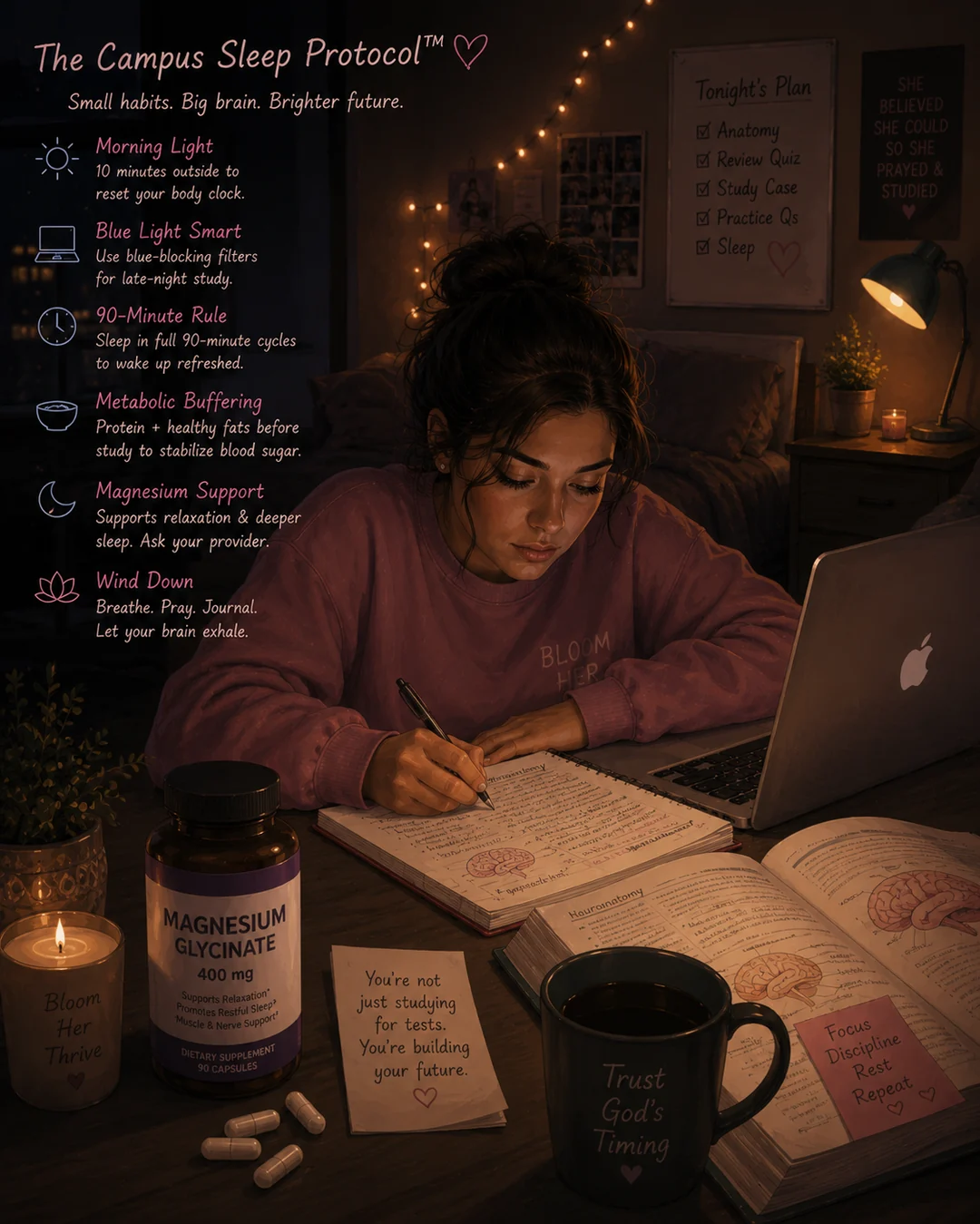
© BloomHer Health 2026 · All Rights Reserved
Your brain doesn't require perfection. It requires consistency.
Introduction
Real Life Doesn't Look Perfect
Let's be honest.
College life is unpredictable.
Some nights you're studying for an anatomy exam.
Other nights you're working until midnight.
Maybe you're an athlete.
Maybe you're juggling nursing school and a part-time job.
Maybe you're raising a child while earning your degree.
Perfection isn't realistic.
Fortunately, your brain doesn't require perfection, it requires consistency.
Small daily habits repeated over time can dramatically improve sleep quality, reduce stress, enhance focus, and support long-term brain health.
The goal isn't to sleep ten hours every night.
The goal is to help your nervous system recover as often as possible.
At BloomHer, we call this protecting your future brain.
Step One: Reset Your Internal Clock Every Morning
One of the fastest ways to improve sleep actually happens within the first hour after waking.
Your brain's master biological clock, called the suprachiasmatic nucleus (SCN), relies on morning light to synchronize your circadian rhythm.
Within 30 to 60 minutes of waking:
- •Walk outside.
- •Skip the sunglasses for a few minutes if it is comfortable and safe.
- •Spend approximately 10 minutes in natural morning sunlight.
If the weather is cloudy, spend a little longer outdoors.
Morning sunlight helps:
- •Suppress melatonin naturally
- •Improve daytime alertness
- •Strengthen your biological clock
- •Increase nighttime melatonin release
- •Improve sleep quality later that evening
Think of morning sunlight as pressing the "reset button" on your brain every day.
Step Two: Protect Your Brain From Blue Light
College often means late-night laptop sessions.
Unfortunately, bright screens tell your brain it's still daytime.
Blue wavelengths suppress melatonin production, making it harder to fall asleep.
You don't have to stop studying.
Simply study smarter.
Consider:
- •Activating Night Shift (Apple) or Night Light (Windows)
- •Using blue-light filtering applications such as f.lux
- •Lowering screen brightness after sunset
- •Avoiding unnecessary scrolling during study breaks
- •Turning off overhead LED lighting when possible
Even small reductions in blue-light exposure may help support your body's natural sleep rhythm.
Step Three: The 90-Minute Sleep Cycle Strategy
Sleep occurs in cycles lasting approximately 90 minutes, although this varies slightly between individuals.
Each cycle includes:
- •Light sleep
- •Deep slow-wave sleep
- •REM sleep
Whenever possible, aim to wake at the end of a complete sleep cycle rather than in the middle of deep sleep.
Many students find they feel more refreshed after approximately:
- •7 and a half hours (five cycles)
- •9 hours (six cycles)
If you must shorten your sleep because of exams or clinical rotations, try to preserve complete sleep cycles rather than randomly cutting sleep.
This strategy may reduce morning grogginess and improve alertness.
Remember:
Five quality sleep cycles are usually far better than six interrupted ones.
Step Four: Stabilize Your Brain's Fuel Supply
Many students unknowingly study on an empty stomach.
Hours later, blood sugar begins falling.
Your brain responds by releasing cortisol and adrenaline to maintain glucose availability.
These stress hormones increase alertness temporarily but may also make it harder to relax later.
Instead of relying solely on sugary snacks or energy drinks, consider a balanced snack before a long evening study session.
Examples include:
- •Greek yogurt with berries
- •Cottage cheese and fruit
- •Apple slices with natural peanut or almond butter
- •Cheese with whole-grain crackers
- •Hard-boiled eggs
- •Roasted chickpeas
Protein combined with healthy fats and fiber helps provide a steadier source of energy than highly processed snacks.
If you have diabetes or another medical condition, discuss individualized nutrition recommendations with your healthcare provider or registered dietitian.
Step Five: Magnesium and Brain Relaxation
Magnesium participates in hundreds of enzymatic reactions throughout the body, including many involved in nerve function and muscle relaxation.
Some forms commonly used in research include:
Magnesium Glycinate
Often selected because it is generally well tolerated and may support relaxation.
Magnesium L-Threonate
A form that has been studied for its ability to raise magnesium levels within the central nervous system, though research is still evolving.
Supplements are not appropriate for everyone and can interact with medications or certain medical conditions. Always speak with your healthcare provider before starting any supplement.
Food sources of magnesium include:
- •Pumpkin seeds
- •Almonds
- •Cashews
- •Spinach
- •Black beans
- •Avocados
- •Dark chocolate (in moderation)
Food first.
Supplements when appropriate.
Step Six: Calm Your Nervous System Before Bed
Your brain cannot transition into deep restorative sleep while it believes you're facing danger.
Spend the last 15 to 20 minutes before bed intentionally slowing your nervous system.
Try:
- •Gentle stretching
- •Prayer or devotional reading
- •Gratitude journaling
- •Slow diaphragmatic breathing
- •Progressive muscle relaxation
- •Listening to calming music
- •Keeping your bedroom cool, dark, and quiet
These habits tell your brain:
"You are safe."
That message alone can make falling asleep easier.
Step Seven: Stop Chasing Perfection
One poor night of sleep will not ruin your health.
Neither will one all-night study session.
What matters most is your overall pattern.
Protect sleep whenever possible.
Recover when life becomes hectic.
Ask for help if insomnia, anxiety, or overwhelming fatigue begin interfering with school or daily life.
Sleep is not time lost.
It is one of the greatest investments you can make in your education, emotional health, metabolism, and future success.
At BloomHer, we believe that the strongest students aren't the ones who stay awake the longest.
They're the ones who understand that a well-rested brain learns faster, thinks more clearly, manages stress better, and performs at its highest potential.
Because when your brain sleeps well...
Your future blooms.
Step Into Your Bloom
You don't need a perfect schedule to protect your brain, you need a few consistent habits that fit real college life. To build a personalized sleep and study-energy plan that works around your classes, work, and life, book a private 1-on-1 BloomHer consultation with me today.
Research and References
Curated sources for further reading. Educational only, not medical advice.
- American Academy of Sleep Medicine. Clinical Practice Guideline for Adult Sleep Health and Insomnia.
- National Sleep Foundation. Sleep Duration Recommendations and Healthy Sleep Guidelines.
- Walker MP. Why We Sleep: Unlocking the Power of Sleep and Dreams. Scribner.
- Harvard Medical School Division of Sleep Medicine. Healthy Sleep: Understanding Circadian Rhythms and Sleep Cycles.
- Czeisler CA, et al. Circadian Rhythms and Human Performance. New England Journal of Medicine.
- National Institutes of Health Office of Dietary Supplements. Magnesium Fact Sheet for Health Professionals.
- Centers for Disease Control and Prevention (CDC). Sleep and Student Health.
- Xie L, Kang H, Xu Q, et al. Sleep Drives Metabolite Clearance from the Adult Brain. Science. 2013.

About the Author
Angel Laurent, M.Ed.
Angel Laurent is a certified Holistic Health Practitioner, neuro-coach, and founder of BloomHer.health. With a Master's in Education and advanced training in neuroscience and metabolic health, she has dedicated her career to dismantling the "one-size-fits-all" approach to women's wellness, and is the creator of the Let Her Bloom Series and The Ateliers for Women's Health curriculum.
Through high-touch, one-on-one partnerships, her work centers on five pillars of modern women's wellness:
- •Neuro-Somatic Regulation: Chronic burnout, nervous system dysregulation, and the psychological "saboteurs" that stall well-being.
- •Metabolic Optimization: Restoring cellular energy, balancing blood sugar, and reversing insulin resistance behind stubborn weight gain and fatigue.
- •Endocrine & Hormone Synergy: Perimenopause, menopause, and hormonal transitions through evidence-based, holistic interventions.
- •Gut-Brain Axis Restoration: Healing the gut microbiome to enhance cognitive clarity, mood stability, and immune resilience.
- •Epigenetic Lifestyle Design: Bespoke lifestyle protocols to reclaim vitality, executive function, and physical longevity.
Have a question, or want to work with Angel? Reach her at hello@bloomher.health.
Every Woman. At Every Age. The BloomHer Way.
Don't miss a post
Get new insights from Angel Laurent delivered straight to your inbox.
No spam. Unsubscribe anytime.
