Journal · Hormones
College & Young WomenEndocrine Sabotage: How Sleep Deprivation Disrupts Hormones, Cycles, and Athletic Performance
By Angel Laurent · June 2026 · 9 min read
© BloomHer Health 2026 · All Rights Reserved
Your body is not failing. It is trying to protect you.
Introduction
"I've Never Missed a Period Before."
You're a college athlete.
You eat well.
You train hard.
You attend class, practice, study late into the night, and somehow still try to maintain a social life.
Then something changes.
Your period arrives late.
The following month it's even later.
Eventually it doesn't come at all.
You assume it's because you're stressed.
In reality, your brain may be making a calculated survival decision.
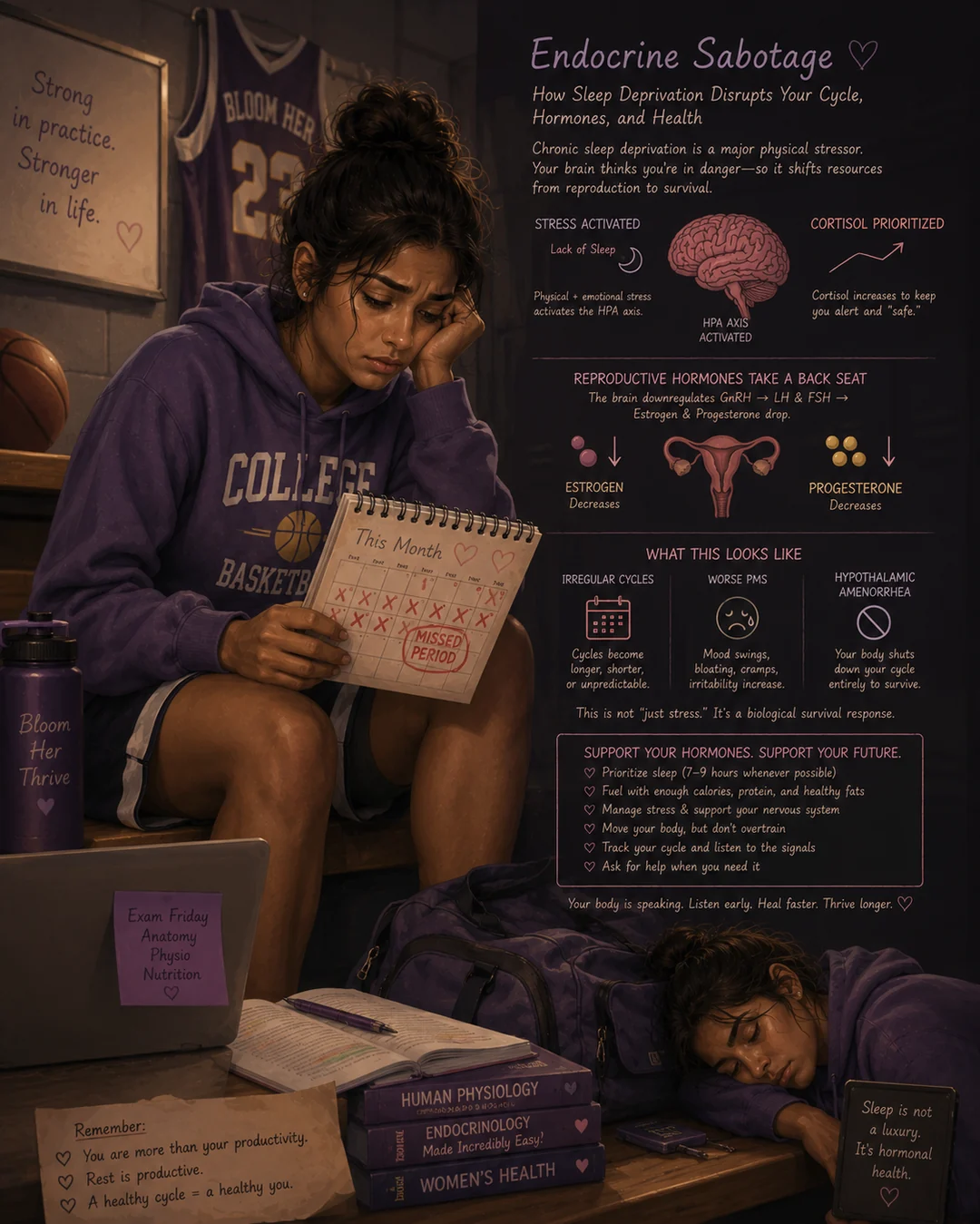
Modern endocrinology has shown that sleep deprivation is far more than simply feeling tired. Chronic sleep loss acts as a powerful physical stressor, activating the body's stress response and altering communication between the brain and the reproductive system.
For many college women, especially student-athletes, this can contribute to irregular menstrual cycles, worsening PMS symptoms, hormonal imbalances, and, in some cases, hypothalamic amenorrhea.
Your body is not failing.
It is trying to protect you.
Your Brain Always Chooses Survival First
Your brain constantly evaluates one important question:
"Am I safe enough to reproduce?"
When the answer is yes, reproductive hormones function normally.
When the answer is no, reproduction becomes a lower priority.
Your brain cannot distinguish between surviving a famine thousands of years ago and surviving modern stressors such as:
- •Chronic sleep deprivation
- •Intense athletic training
- •Emotional stress
- •Poor nutrition
- •Rapid weight loss
- •Academic pressure
- •Overtraining
- •Illness
All of these activate the body's stress response.
Meet the HPA Axis
Your stress response is controlled by the Hypothalamic-Pituitary-Adrenal (HPA) Axis.
When your brain senses stress:
The hypothalamus releases corticotropin-releasing hormone (CRH).
The pituitary gland releases adrenocorticotropic hormone (ACTH).
The adrenal glands release cortisol.
Cortisol is an incredible survival hormone.
It raises blood sugar.
Keeps you alert.
Increases available energy.
Reduces inflammation temporarily.
Helps you survive emergencies.
The problem develops when the emergency never ends.
Late-night studying.
Early morning workouts.
Constant phone notifications.
Poor sleep.
Academic deadlines.
These become chronic stressors.
The body continues producing cortisol long after it should have returned to baseline.
What Happens to Reproductive Hormones?
The brain has limited resources.
When survival hormones remain elevated, reproduction becomes less important.
The hypothalamus begins reducing production of gonadotropin-releasing hormone (GnRH).
As GnRH falls:
- •Luteinizing Hormone (LH) decreases.
- •Follicle-Stimulating Hormone (FSH) decreases.
- •Ovulation becomes less consistent.
- •Progesterone production falls.
- •Estrogen balance becomes disrupted.
The result may include:
- •Irregular menstrual cycles
- •Delayed ovulation
- •Missed periods
- •Worsening PMS
- •Mood swings
- •Fatigue
- •Difficulty recovering after exercise
For some women, the menstrual cycle may temporarily stop altogether.
Understanding Hypothalamic Amenorrhea
One of the most important conditions affecting young women is Functional Hypothalamic Amenorrhea (FHA).
Unlike menopause or ovarian disease, FHA begins in the brain.
The ovaries are often healthy.
The uterus is healthy.
The problem is that the brain temporarily suppresses reproductive hormone signaling because it believes the body is under too much stress.
Common contributors include:
- •Chronic sleep deprivation
- •Restrictive dieting
- •Low energy availability
- •Intense athletic training
- •Significant emotional stress
- •Rapid weight loss
This condition is especially common among:
- •Basketball players
- •Distance runners
- •Gymnasts
- •Dancers
- •Swimmers
- •Cross-country athletes
Ignoring missed periods is never recommended.
A menstrual cycle is often considered a vital sign of overall health in reproductive-age women.
Why Sleep Matters More Than You Think
Deep sleep is when your body performs much of its hormonal repair.
During healthy sleep your body:
- •Regulates cortisol
- •Supports growth hormone release
- •Restores muscle tissue
- •Strengthens immunity
- •Supports reproductive hormone signaling
- •Rebalances the nervous system
Missing these restorative processes night after night places additional stress on an already demanding college lifestyle.
Recovery becomes slower.
Mood becomes less stable.
Injuries become more likely.
Academic performance may decline.
The BloomHer Campus Hormone Reset
At BloomHer, we encourage student-athletes to think about recovery as part of training, not a reward after training.
Prioritize Sleep
Aim for seven to nine hours whenever possible and maintain a consistent sleep schedule.
Fuel Your Body
Adequate calories, protein, healthy fats, calcium, vitamin D, and iron are essential for hormone production and athletic recovery.
Respect Rest Days
Recovery days improve long-term performance and reduce the risk of overtraining.
Manage Stress
Prayer, journaling, breathing exercises, mindfulness, and supportive relationships help calm the nervous system and reduce chronic cortisol activation.
Track Your Menstrual Cycle
Keep a simple calendar or app to monitor:
- •Cycle length
- •Flow
- •Symptoms
- •Missed periods
Changes may provide important information to discuss with your healthcare provider.
Seek Medical Evaluation
If you miss three consecutive menstrual cycles, experience persistent irregular periods, or have concerns about your reproductive health, schedule an evaluation with your healthcare provider, sports medicine physician, or gynecologist.
The BloomHer Perspective
Your menstrual cycle is more than a monthly inconvenience.
It reflects communication between your brain, hormones, metabolism, nutrition, and nervous system.
When your body delays or pauses your cycle, it is often sending an important message.
Listen to it.
College should challenge your mind, not compromise your health.
By protecting your sleep, fueling your body, managing stress, and allowing time for recovery, you are investing in far more than athletic performance.
You are protecting your future fertility, bone health, metabolism, emotional well-being, and lifelong vitality.
At BloomHer, we believe the strongest women are not those who push through exhaustion.
They are the women who understand that recovery is part of success.
Because your hormones cannot bloom if your brain never has the opportunity to rest.
Step Into Your Bloom
A missed or irregular cycle is your body sending an important message, and it deserves real attention, not dismissal. If you are a student-athlete navigating cycle changes, fatigue, or recovery struggles, a thoughtful evaluation matters first with your provider, and BloomHer can help you build a sleep, fueling, and recovery plan alongside that care. Book a private 1-on-1 BloomHer consultation with me today.
Research and References
Curated sources for further reading. Educational only, not medical advice.
- American College of Obstetricians and Gynecologists (ACOG). Committee Opinion: Menstruation in Girls and Adolescents, Using the Menstrual Cycle as a Vital Sign.
- De Souza MJ, et al. The Female Athlete Triad Coalition Consensus Statement on Treatment and Return to Play. British Journal of Sports Medicine.
- Gordon CM, et al. Functional Hypothalamic Amenorrhea: An Endocrine Society Clinical Practice Guideline. Journal of Clinical Endocrinology and Metabolism.
- American College of Sports Medicine. Female Athlete Triad Position Stand.
- National Institutes of Health Office of Research on Women's Health. Women's Sleep, Hormones, and Reproductive Health.

About the Author
Angel Laurent, M.Ed.
Angel Laurent is a certified Holistic Health Practitioner, neuro-coach, and founder of BloomHer.health. With a Master's in Education and advanced training in neuroscience and metabolic health, she has dedicated her career to dismantling the "one-size-fits-all" approach to women's wellness, and is the creator of the Let Her Bloom Series and The Ateliers for Women's Health curriculum.
Through high-touch, one-on-one partnerships, her work centers on five pillars of modern women's wellness:
- •Neuro-Somatic Regulation: Chronic burnout, nervous system dysregulation, and the psychological "saboteurs" that stall well-being.
- •Metabolic Optimization: Restoring cellular energy, balancing blood sugar, and reversing insulin resistance behind stubborn weight gain and fatigue.
- •Endocrine & Hormone Synergy: Perimenopause, menopause, and hormonal transitions through evidence-based, holistic interventions.
- •Gut-Brain Axis Restoration: Healing the gut microbiome to enhance cognitive clarity, mood stability, and immune resilience.
- •Epigenetic Lifestyle Design: Bespoke lifestyle protocols to reclaim vitality, executive function, and physical longevity.
Have a question, or want to work with Angel? Reach her at hello@bloomher.health.
Every Woman. At Every Age. The BloomHer Way.
Don't miss a post
Get new insights from Angel Laurent delivered straight to your inbox.
No spam. Unsubscribe anytime.
