
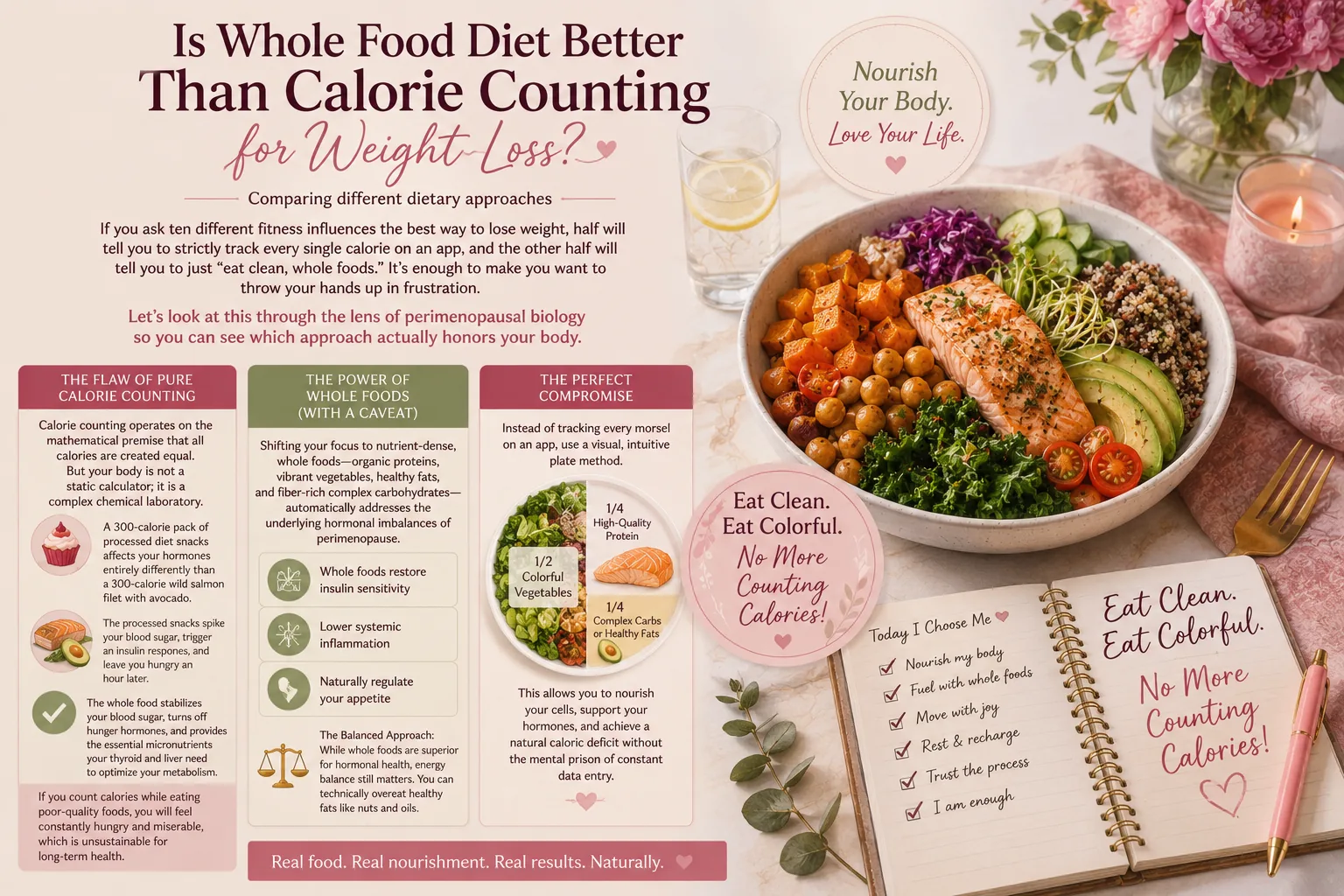
If you ask ten different fitness influencers the best way to lose weight, half will tell you to strictly track every single calorie on an app, and the other half will tell you to just "eat clean, whole foods." It is enough to make you want to throw your hands up in frustration.
Let us look at this through the lens of perimenopausal biology so you can see which approach actually honors your body. And if the noise of contradictory advice is what wore you out in the first place, I wrote about exactly that in why healthy eating feels so complicated after 40.
The flaw of pure calorie counting
Calorie counting operates on the mathematical premise that all calories are created equal. But your body is not a static calculator; it is a complex chemical laboratory.
- A 300-calorie pack of processed diet snacks affects your hormones entirely differently than a 300-calorie wild salmon filet with avocado.
- The processed snacks spike your blood sugar, trigger an insulin response, and leave you hungry an hour later.
- The whole food stabilizes your blood sugar, turns off hunger hormones, and provides the essential micronutrients your thyroid and liver need to optimize your metabolism.
If you count calories while eating poor-quality foods, you will feel constantly hungry and miserable, which is unsustainable for long-term health. This is the exact insulin and satiety story I told in the carb article and the satiety article: to a perimenopausal body, quality is not a footnote to quantity. It often outranks it.
The power of whole foods, with a caveat
Shifting your focus to nutrient-dense, whole foods, organic proteins, vibrant vegetables, healthy fats, and fiber-rich complex carbohydrates, automatically addresses the underlying hormonal imbalances of perimenopause. Whole foods restore insulin sensitivity, lower systemic inflammation, and naturally regulate your appetite so you do not need to obsess over tracking.
The balanced approach: while whole foods are superior for hormonal health, energy balance still matters. You can technically overeat healthy fats like nuts and oils. Whole food is not a license for unlimited quantity; it is a strategy that makes the right quantity happen almost automatically, because real food satisfies in a way processed food is engineered never to.
The perfect compromise: the plate method
Instead of tracking every morsel on an app, use a visual, intuitive plate method. Fill half your plate with colorful vegetables, one-quarter with high-quality protein, and the remaining quarter with complex carbs or healthy fats. This allows you to nourish your cells, support your hormones, and achieve a natural caloric deficit without the mental prison of constant data entry.
Notice what this method quietly does: it builds the protein-anchored, blood-sugar-stable plate from what to eat in perimenopause without a single number, and it hits the protein target from the protein article by structure rather than by math. You get the precision of counting and the freedom of intuitive eating, without the downside of either.
How we personalize it for you
The plate is the starting framework, and your body fine-tunes it. Working practitioner-led through BloomHer, alongside your primary care doctor and our network provider, we read your comprehensive lab testing for optimal to see what your metabolism, thyroid, and liver actually need, then track your foods, weight, moods, and sleep cycles in the BloomHer membership app so we can adjust your plate on evidence, not guesswork. Your method, ShapeUp as the foundation, Fire inside Radiance, Butter inside Full Bloom, tunes the ratios to your data as your body changes. That is how you get the personalization of tracking without ever becoming its prisoner.
So is whole food better than calorie counting? For a perimenopausal body, food quality is the more powerful lever, but you do not have to choose sides in someone else's internet argument. Build the plate, eat real food until you are genuinely satisfied, let your hormones do the regulating they were designed to do, and put the calculator down. Your body was always smarter than the app.