Journal · Emotional Health
Emotional HealthThe Neurobiology of Betrayal: How Infidelity Can Rewire a Woman's Brain and Body
By Angel Laurent · June 2026 · 8 min read
© BloomHer Health 2026 · All Rights Reserved
This is not simply emotional pain. It is a whole-body survival response.
Introduction
The Physical Reality of a Broken Heart
When a woman discovers that the person she trusted most has betrayed her, something extraordinary happens inside her body.
Her heart races.
Her hands shake.
Her stomach drops.
She may feel nauseated.
Food suddenly becomes unappealing.
She cannot sleep.
Her chest literally hurts.
Her mind replays every conversation looking for clues she missed.
Many women describe feeling as though the floor has disappeared beneath them.
Others say they no longer recognize themselves.
Friends often encourage her to "move on," "be strong," or "stop thinking about it."
Yet she cannot.
Not because she is weak.
Because her brain believes her world has become unsafe.
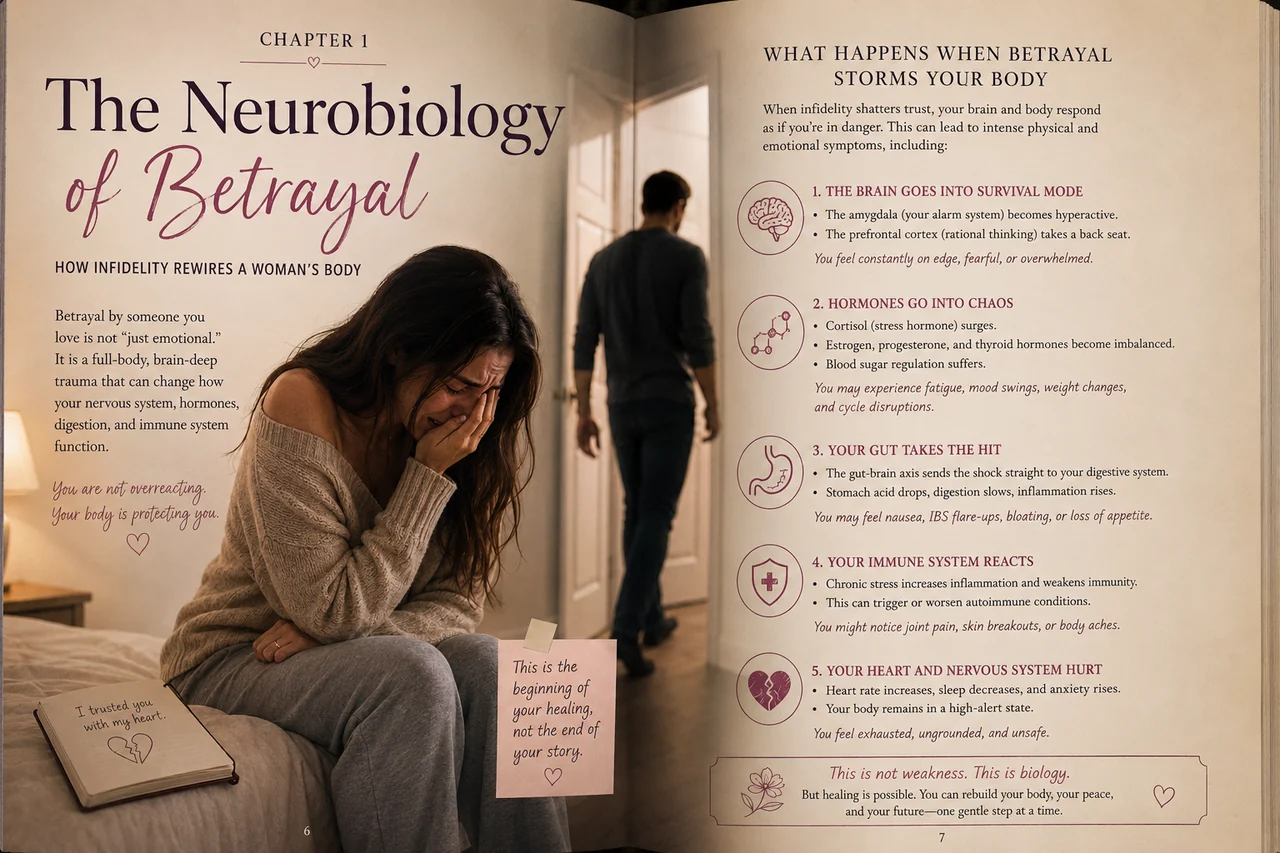
Modern trauma research has demonstrated that profound relational betrayal can activate many of the same brain networks involved in post-traumatic stress. Although not every person who experiences infidelity develops PTSD, betrayal by a trusted partner can produce intense physiological stress responses, intrusive thoughts, hypervigilance, sleep disruption, and emotional dysregulation that closely resemble traumatic stress reactions.
This is not simply emotional pain.
It is a whole-body survival response.
Your brain, hormones, immune system, digestive tract, and nervous system begin reacting together in an attempt to protect you from future danger.
Understanding these changes is the first step toward healing.
Your Brain Was Designed for Attachment
Human beings are wired for connection.
Healthy attachment relationships provide far more than companionship.
They create biological safety.
Throughout evolution, surviving alone dramatically reduced the chances of living long enough to raise children.
Because of this, the human brain developed powerful attachment systems.
When you trust someone deeply, your brain begins predicting safety in their presence.
Their voice calms your nervous system.
Their touch lowers stress hormones.
Their presence often slows your heart rate.
You literally become biologically regulated together.
Scientists sometimes refer to this as co-regulation.
In healthy relationships, your nervous system repeatedly learns:
"I am safe."
When infidelity is discovered, that internal safety map suddenly collapses.
The person who represented protection now becomes associated with danger.
For many women, this neurological shift occurs within minutes.
The brain immediately begins asking one overwhelming question:
"If I was wrong about the person I trusted most, what else am I missing?"
That uncertainty becomes exhausting.
Betrayal Changes the Way the Brain Processes Threat
One of the first structures activated after traumatic emotional events is the amygdala.
The amygdala functions as the brain's alarm center.
Its job is not to think.
Its job is to survive.
Once activated, it scans constantly for additional threats.
After betrayal, many women notice:
- •Obsessively reviewing text messages.
- •Replaying conversations.
- •Searching for hidden meanings.
- •Checking phones or social media repeatedly.
- •Difficulty trusting anyone.
- •Startling easily.
- •Feeling constantly "on edge."
- •Sleeping lightly or waking throughout the night.
These reactions often confuse women.
They wonder,
"Why can't I just stop thinking about it?"
The answer is simple.
Your survival system believes paying attention keeps you safe.
Unfortunately, once the threat has passed, the nervous system doesn't always know how to turn itself off.
Why You Feel Like You're Losing Yourself
When the amygdala becomes highly activated, another important part of the brain becomes less efficient.
This area is called the prefrontal cortex.
The prefrontal cortex helps you:
- •Think logically.
- •Plan ahead.
- •Regulate emotions.
- •Solve problems.
- •Control impulses.
- •Make thoughtful decisions.
Under extreme stress, the brain temporarily shifts resources away from long-term planning and toward immediate survival.
This explains why many women say:
"I know I'm overthinking this, but I can't stop."
Or...
"I don't even recognize myself anymore."
You are not "going crazy."
Your brain is temporarily prioritizing survival over reasoning.
This response is adaptive during genuine danger.
The challenge is that emotional betrayal may keep this alarm system activated long after the initial discovery, particularly if trust remains uncertain or repeated disclosures continue.
Why Your Body Hurts Even Though Your Heart Was Broken
Heartbreak is not "all in your head."
Functional brain imaging studies have shown that emotional rejection activates many of the same neural pathways involved in physical pain.
This helps explain why women commonly experience:
- •Tightness in the chest.
- •Shortness of breath.
- •Muscle tension.
- •Headaches.
- •Fatigue.
- •Loss of appetite.
- •Trembling.
- •Stomach pain.
- •Tearfulness without warning.
Your nervous system does not clearly separate emotional danger from physical danger.
To your brain, the loss of a primary attachment relationship can feel like a threat to survival.
That is why healing must involve more than simply "thinking differently."
The body must also learn that the immediate danger has passed.
In the next section, we'll explore how prolonged activation of the stress response affects cortisol, thyroid function, blood sugar regulation, menstrual health, and why many women notice dramatic changes in their weight, hormones, and overall physical health after betrayal.
Step Into Your Bloom
If betrayal has left your body in a constant state of high alert, please know this is biology, not weakness, and you do not have to navigate it alone. BloomHer supports women through the physical side of emotional trauma, calming the nervous system, restoring hormones and sleep, and rebuilding strength one gentle step at a time. Book a private 1-on-1 BloomHer consultation with me today.

About the Author
Angel Laurent, M.Ed.
Angel Laurent is a certified Holistic Health Practitioner, neuro-coach, and founder of BloomHer.health. With a Master's in Education and advanced training in neuroscience and metabolic health, she has dedicated her career to dismantling the "one-size-fits-all" approach to women's wellness, and is the creator of the Let Her Bloom Series and The Ateliers for Women's Health curriculum.
Through high-touch, one-on-one partnerships, her work centers on five pillars of modern women's wellness:
- •Neuro-Somatic Regulation: Chronic burnout, nervous system dysregulation, and the psychological "saboteurs" that stall well-being.
- •Metabolic Optimization: Restoring cellular energy, balancing blood sugar, and reversing insulin resistance behind stubborn weight gain and fatigue.
- •Endocrine & Hormone Synergy: Perimenopause, menopause, and hormonal transitions through evidence-based, holistic interventions.
- •Gut-Brain Axis Restoration: Healing the gut microbiome to enhance cognitive clarity, mood stability, and immune resilience.
- •Epigenetic Lifestyle Design: Bespoke lifestyle protocols to reclaim vitality, executive function, and physical longevity.
Have a question, or want to work with Angel? Reach her at hello@bloomher.health.
Every Woman. At Every Age. The BloomHer Way.
Don't miss a post
Get new insights from Angel Laurent delivered straight to your inbox.
No spam. Unsubscribe anytime.
