Journal · Sleep
College & Young WomenThe Neurological Cost of Sleep Deprivation: Glymphatic Drainage and the Brain Fog Epidemic
By Angel Laurent · June 2026 · 8 min read
© BloomHer Health 2026 · All Rights Reserved
While you sleep, your brain isn't shutting down. It is working harder than you realize.
Introduction
Why Am I So Exhausted, Even After Sleeping?
You made it to college.
You're chasing your dreams.
You're studying harder than ever before.
Yet somehow your brain feels slower than it did in high school.
You forget assignments.
You can't focus during lectures.
Reading the same paragraph three times has become normal.
Your anxiety feels out of control.
You're constantly exhausted.
You rely on coffee to survive.
You tell yourself you'll catch up on sleep over the weekend.
Unfortunately, your brain doesn't work that way.
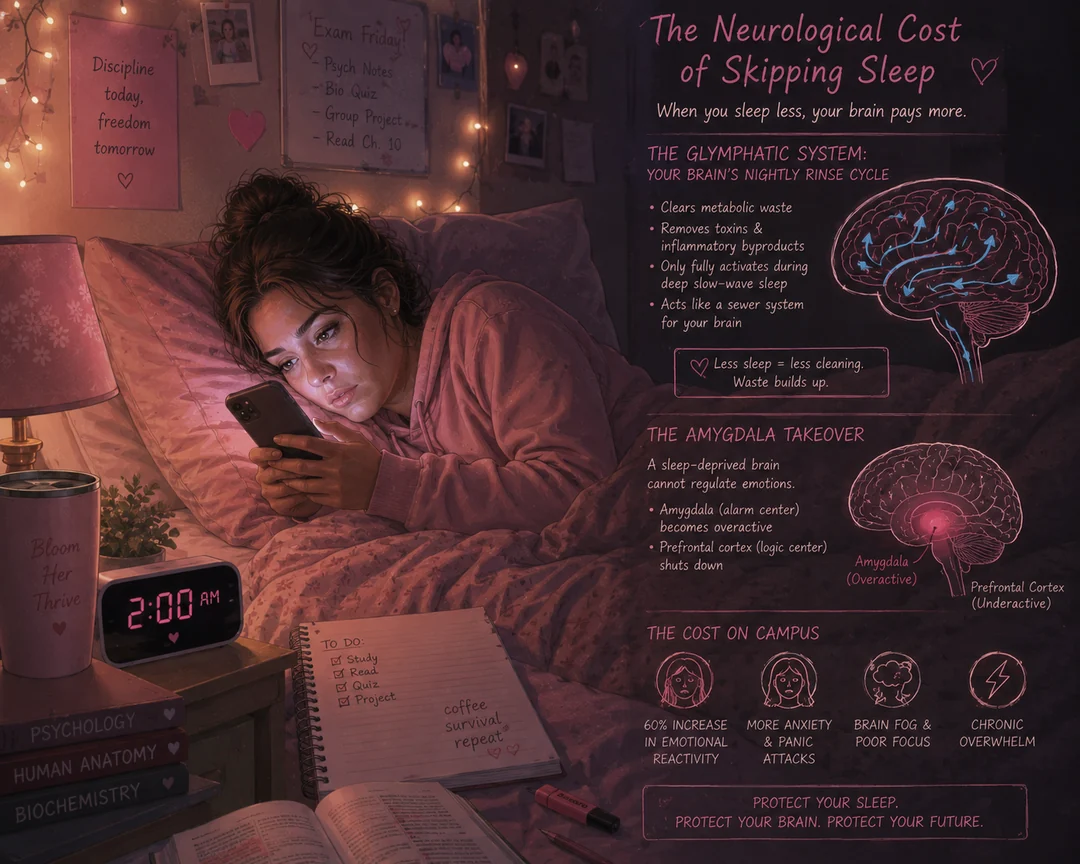
Modern neuroscience has completely changed what we understand about sleep. Sleep is no longer viewed as simply "rest." Instead, scientists now recognize sleep as one of the most important biological maintenance periods your body experiences every twenty-four hours.
While you sleep, your brain isn't shutting down.
It is working harder than you realize.
It is repairing damaged neurons.
It is strengthening memories.
It is balancing hormones.
It is regulating your immune system.
It is organizing everything you learned throughout the day.
Most importantly...
It is cleaning itself.
This nightly cleaning process is one of the greatest neurological discoveries of the past decade.
Scientists call it the glymphatic system.
Your Brain Has Its Own Cleaning Crew
Imagine living in a house where nobody ever took out the trash.
Every day garbage piles up.
Eventually the house becomes difficult to live in.
The same thing happens inside your brain.
Throughout the day your brain produces waste products as billions of nerve cells communicate with one another.
These metabolic byproducts are completely normal.
The problem occurs when they aren't removed.
For decades scientists believed the brain had no true waste removal system.
Then researchers discovered something remarkable.
During deep slow-wave sleep, tiny channels surrounding blood vessels expand by nearly 60 percent.
This expansion allows cerebrospinal fluid to move through brain tissue like a gentle washing machine.
As this fluid circulates, it removes metabolic waste, inflammatory molecules, damaged proteins, and other cellular debris that accumulated throughout the day.
Researchers named this remarkable process the glymphatic system because it functions similarly to the body's lymphatic system while relying heavily on specialized brain cells called glia.
Think of it as your brain's overnight housekeeping service.
Every single night your brain literally washes itself.
Deep Sleep Is Where the Magic Happens
Not every stage of sleep activates the glymphatic system equally.
The greatest amount of waste removal occurs during deep slow-wave sleep.
This stage is also when your body:
- •Repairs muscle tissue
- •Releases growth hormone
- •Strengthens immunity
- •Builds long-term memories
- •Restores mental energy
- •Regulates blood sugar
- •Supports emotional resilience
When students regularly sleep only four to six hours, they dramatically reduce the amount of deep sleep available.
Instead of completing the brain's nightly maintenance cycle, the cleaning process is interrupted.
Night after night.
Week after week.
Month after month.
Eventually the effects become noticeable.
What Happens When the Brain Doesn't Get Cleaned?
Imagine never emptying the trash in your dorm room.
Eventually everything becomes cluttered.
The same principle applies inside your brain.
When sleep becomes chronically restricted, metabolic waste is cleared less efficiently.
Although researchers are still studying the long-term implications, insufficient sleep has been associated with:
- •Brain fog
- •Poor concentration
- •Memory difficulties
- •Slower reaction times
- •Reduced learning capacity
- •Increased mental fatigue
- •Lower academic performance
College students often assume these symptoms simply mean they need another cup of coffee.
In reality, many are asking an exhausted brain to perform while it is overdue for essential overnight maintenance.
No amount of caffeine can replace the restorative work that only deep sleep can accomplish.
Why Women May Feel the Effects More Intensely
Young women face unique challenges that further increase vulnerability to sleep disruption.
Hormonal fluctuations throughout the menstrual cycle influence sleep quality.
Academic pressure continues to rise.
Many young women balance school with athletics, employment, internships, leadership roles, family responsibilities, and social commitments.
Late-night studying is often followed by early morning classes.
Add constant phone notifications, social media, and blue-light exposure, and the brain rarely receives the uninterrupted deep sleep it desperately needs.
The result is not simply feeling tired.
It is a brain that never fully resets.
And when the brain cannot reset, emotional regulation begins to suffer.
That is where another remarkable structure takes over, the amygdala.
In the next part of this series, we'll explore how inadequate sleep weakens the brain's "executive control center" and allows the amygdala, your brain's alarm system, to become dramatically more reactive, increasing anxiety, emotional overwhelm, and panic-like symptoms.
Step Into Your Bloom
If brain fog, exhaustion, and anxiety are stealing your focus, the most powerful fix isn't more caffeine, it is protecting the deep sleep your brain uses to clean and reset itself. To build a personalized brain-and-sleep plan, book a private 1-on-1 BloomHer consultation with me today.

About the Author
Angel Laurent, M.Ed.
Angel Laurent is a certified Holistic Health Practitioner, neuro-coach, and founder of BloomHer.health. With a Master's in Education and advanced training in neuroscience and metabolic health, she has dedicated her career to dismantling the "one-size-fits-all" approach to women's wellness, and is the creator of the Let Her Bloom Series and The Ateliers for Women's Health curriculum.
Through high-touch, one-on-one partnerships, her work centers on five pillars of modern women's wellness:
- •Neuro-Somatic Regulation: Chronic burnout, nervous system dysregulation, and the psychological "saboteurs" that stall well-being.
- •Metabolic Optimization: Restoring cellular energy, balancing blood sugar, and reversing insulin resistance behind stubborn weight gain and fatigue.
- •Endocrine & Hormone Synergy: Perimenopause, menopause, and hormonal transitions through evidence-based, holistic interventions.
- •Gut-Brain Axis Restoration: Healing the gut microbiome to enhance cognitive clarity, mood stability, and immune resilience.
- •Epigenetic Lifestyle Design: Bespoke lifestyle protocols to reclaim vitality, executive function, and physical longevity.
Have a question, or want to work with Angel? Reach her at hello@bloomher.health.
Every Woman. At Every Age. The BloomHer Way.
Don't miss a post
Get new insights from Angel Laurent delivered straight to your inbox.
No spam. Unsubscribe anytime.
