Journal · Libido
Sexual WellnessRewiring Female Libido: The Neuro-Endocrine Secret to Desire at Every Age
By Angel Laurent · June 2026 · 10 min read
© BloomHer Health 2026 · All Rights Reserved
God did not design intimacy to disappear after 40, 50, or 70. Your body is asking for safety, balance, and connection, not giving up.
Introduction
Let's Talk About It
Can we have an honest conversation?
Somewhere along the way, women were taught that desire is something we lose with age.
That after children...
After menopause...
After stress...
After cancer...
After 25 years of marriage...
After retirement...
After turning sixty...
...it simply fades away.
But that's not what science tells us.
And it's certainly not what God designed.
Intimacy isn't just about sex.
It's about connection.
Touch.
Laughter.
Playfulness.
Feeling beautiful.
Feeling desired.
Feeling emotionally safe.
Feeling alive.
Modern research suggests that nearly one in two midlife women experiences concerns related to sexual desire, arousal, or satisfaction at some point during the menopause transition or later life. Yet many women never bring it up, not because they don't care, but because they're embarrassed, ashamed, or assume it's simply part of getting older.
It isn't.
Loss of desire is not a character flaw.
It is often a biological message.
Your nervous system may be saying:
I don't feel safe enough to prioritize intimacy.
The beautiful news?
That message can often change.
Desire Is a Vital Sign
Think about what happens when intimacy is healthy.
You laugh more.
You sleep better.
You feel closer to your partner.
Stress feels easier to manage.
You feel feminine.
Confident.
Connected.
Research has associated satisfying sexual health with:
- •Better cardiovascular health
- •Improved sleep
- •Reduced stress
- •Increased oxytocin
- •Lower blood pressure
- •Improved relationship satisfaction
- •Better mental health
- •Greater quality of life
Healthy intimacy isn't simply a luxury.
For many women, it's part of overall wellness.
Every Season Deserves Intimacy
At BloomHer we believe something radical:
You deserve to enjoy intimacy...
At 28.
At 38.
At 48.
At 58.
At 68.
Even at 88.
Your body changes.
Your hormones change.
Your relationship changes.
But your ability to experience connection doesn't have an expiration date.
It simply evolves.
The Biggest Myth
Most people think libido looks like this:
Hormone drops.
Desire drops.
Problem solved.
Women's biology is infinitely more sophisticated.
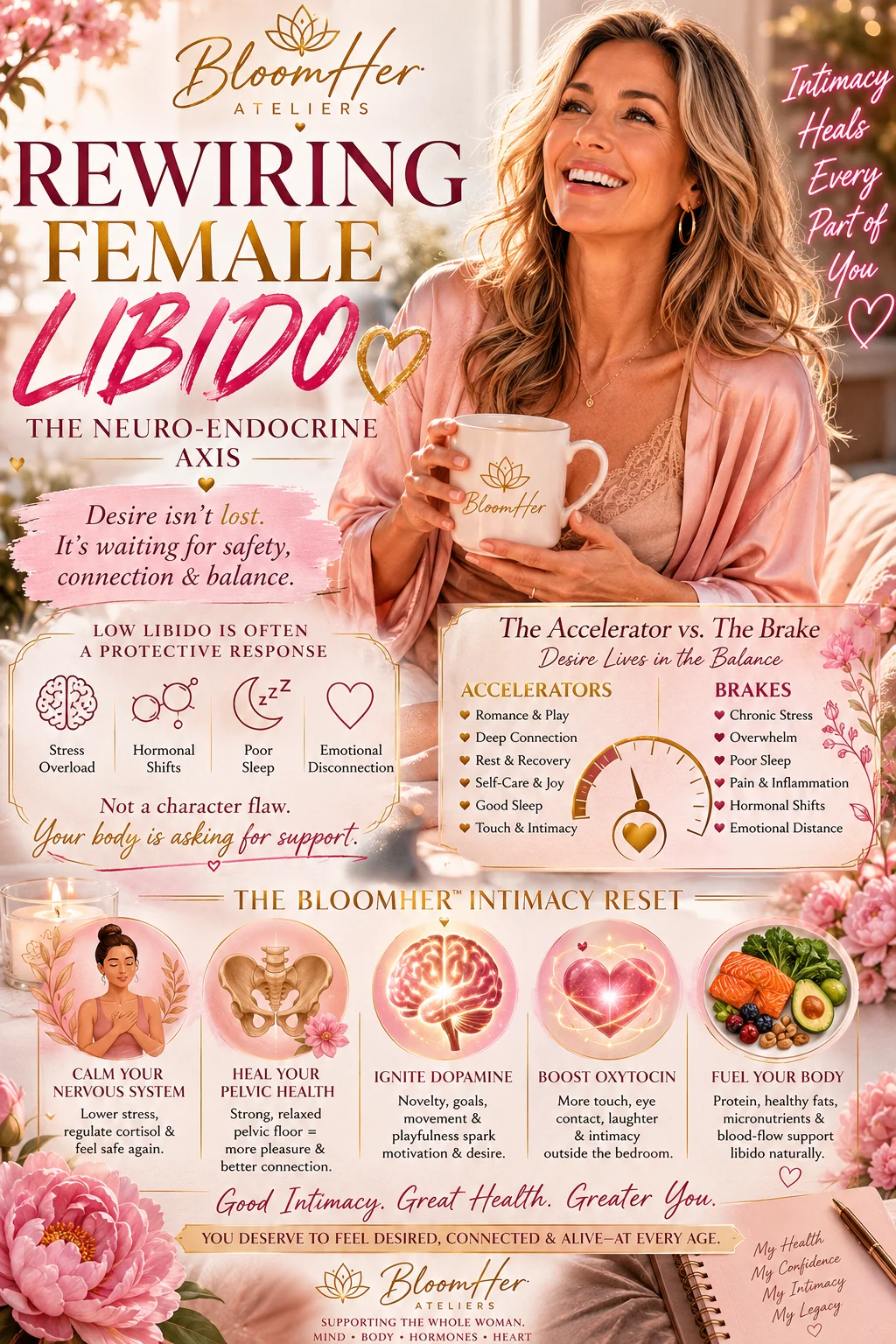
Female desire lives inside an intricate conversation between:
- •The brain
- •The nervous system
- •Hormones
- •Blood flow
- •Emotional connection
- •Sleep
- •Stress
- •Relationship safety
- •Physical comfort
- •Body image
That's why giving every woman testosterone isn't the answer.
Sometimes hormones are part of the picture.
Sometimes they aren't.
Meet Your Accelerator and Brake
One of the most influential concepts in female sexual medicine comes from researcher Dr. Emily Nagoski, who describes sexual desire as a system with an accelerator and brakes.
Your Accelerator
These are the things that tell your brain:
"This feels good."
"I feel beautiful."
"I'm emotionally connected."
"I'm relaxed."
"I'm excited."
Examples include:
- •Romance
- •Flirting
- •Touch
- •Feeling attractive
- •Emotional intimacy
- •Vacation
- •Date night
- •Good sleep
- •Exercise
- •Feeling appreciated
Your Brakes
Now imagine everything pressing the brake pedal.
Bills.
Laundry.
Kids.
Work.
Chronic pain.
Hot flashes.
Poor sleep.
Anxiety.
Body image struggles.
Arguments.
Menopause.
Stress.
Even if your accelerator is working perfectly, if your brakes are fully engaged, nothing happens.
You aren't broken.
Your nervous system is protecting you.
Cortisol, the Ultimate Libido Killer
Your brain has one priority.
Survival.
When cortisol remains elevated for weeks or months, your brain shifts resources away from reproduction and toward protection.
Think about it.
If your body believes you're running from a tiger, it doesn't care about romance.
It cares about survival.
Chronic stress may contribute to:
- •Reduced spontaneous desire
- •Vaginal dryness
- •Poor sleep
- •Fatigue
- •Lower dopamine activity
- •Increased anxiety
- •Difficulty reaching orgasm
The goal isn't simply lowering hormones.
It's helping your nervous system believe:
"I'm safe."
Dopamine, the Spark of Anticipation
Dopamine is often called the motivation molecule.
It's not simply about pleasure.
It's about wanting.
Curiosity.
Anticipation.
Novelty.
Playfulness.
Women with chronically depleted dopamine often describe themselves as saying:
"I'm just never in the mood."
That doesn't mean they don't love their partner.
It means the reward system isn't firing efficiently.
Oxytocin, the Connection Hormone
Oxytocin rises with:
- •Hugging
- •Holding hands
- •Eye contact
- •Kissing
- •Prayer together
- •Massage
- •Breastfeeding
- •Orgasm
- •Genuine affection
This hormone lowers stress while strengthening emotional bonds.
Sometimes rebuilding intimacy begins long before the bedroom.
The Pelvic Floor-Brain Connection
This is one of the most exciting areas of women's health.
Many women think pelvic floor muscles only matter after childbirth.
In reality they influence:
- •Bladder control
- •Core stability
- •Blood flow
- •Orgasm
- •Arousal
- •Sexual comfort
Research suggests pelvic floor dysfunction, including muscles that are either too weak or overly tight, can contribute to pain during intercourse, reduced arousal, and diminished sexual satisfaction.
Pelvic floor physical therapy has become an important, evidence-based treatment for women experiencing painful intercourse, postpartum changes, and some forms of sexual dysfunction.
Healthy intimacy begins with healthy pelvic tissues.
Blood Flow Is Everything
Just like the heart, the brain, and muscles, sexual tissues require circulation.
Healthy blood flow supports:
- •Natural lubrication
- •Arousal
- •Sensation
- •Tissue health
- •Orgasm
Simple lifestyle habits that support vascular health also support sexual health.
Why Menopause Changes Everything
Declining estrogen may contribute to:
- •Vaginal dryness
- •Tissue thinning
- •Reduced blood flow
- •Increased urinary symptoms
- •Pain with intercourse
Some women also experience changes in testosterone levels, mood, sleep, and energy that can influence sexual desire.
Fortunately, many evidence-based treatments, including vaginal moisturizers, lubricants, pelvic floor therapy, and, for appropriate candidates, localized or systemic hormone therapy, can make a meaningful difference.
The BloomHer Intimacy Reset
Step One, Calm Your Nervous System
Daily practices:
- •Deep breathing
- •Prayer
- •Gratitude
- •Walking
- •Nature
- •Gentle stretching
- •Good sleep
A calm nervous system creates room for desire.
Step Two, Restore Pelvic Health
Talk with your healthcare provider about:
- •Pelvic floor physical therapy
- •Vaginal moisturizers
- •Appropriate lubricants
- •Hormonal evaluation when indicated
- •Treatment for pain during intercourse
Pain should never be ignored.
Step Three, Build Dopamine Naturally
Increase healthy dopamine through:
- •Strength training
- •Learning new skills
- •Music
- •Dancing
- •Laughter
- •Sunlight
- •Creative hobbies
- •Accomplishing meaningful goals
Joy fuels desire.
Step Four, Increase Oxytocin Every Day
Try:
- •Hugging for 20 seconds
- •Holding hands
- •Date nights
- •Slow dancing
- •Laughing together
- •Praying together
- •Eye contact without phones
- •Gentle massage
Connection often begins outside the bedroom.
Step Five, Nourish Your Body
Support healthy hormones and vascular function with:
- •Mediterranean-style eating
- •Adequate protein
- •Omega-3 fatty acids
- •Colorful fruits and vegetables
- •Regular movement
- •Healthy sleep
- •Limiting smoking and excessive alcohol
A Word for Single Women
This chapter isn't only for married women.
Learning about your body matters whether you're:
- •Single
- •Dating
- •Widowed
- •Divorced
- •Newly married
Understanding your hormones, nervous system, and sexual health empowers you to care for your body with confidence and without shame.
God's Design
Throughout Scripture, marriage is described as a place of joy, companionship, and mutual love.
Healthy intimacy is one expression of that relationship.
There is no biblical expiration date on affection.
Growing older doesn't mean growing invisible.
Your body deserves compassion.
Your heart deserves connection.
And your marriage deserves intentional investment.
BloomHer's Final Thought
Libido is not simply about hormones.
It is the conversation between your brain, heart, hormones, blood vessels, pelvic floor, sleep, stress, and relationships.
When those systems begin working together again, desire often follows.
You are not broken.
You are wonderfully designed.
Sometimes your body simply needs the right support to remember that.
Step Into Your Bloom
Your desire is not broken, and you do not have to navigate this alone. If you are ready to calm your nervous system, restore your hormones and pelvic health, and feel alive and connected again, book a private 1-on-1 BloomHer consultation with me today.
Research and References
Curated sources for further reading. Educational only, not medical advice.
- The Menopause Society. *2025 Position Statement on Genitourinary Syndrome of Menopause and Female Sexual Health.*
- Clayton AH, Kingsberg SA. Hypoactive Sexual Desire Disorder and Female Sexual Interest/Arousal Disorder. *Mayo Clinic Proceedings.*
- Kingsberg SA, et al. Female Sexual Health Across the Lifespan. *Journal of Women's Health.*
- Nagoski E. *Come As You Are.* Updated science-based edition. (Introduced the Accelerator and Brake model of female sexual response based on contemporary sexual psychophysiology.)
- International Society for the Study of Women's Sexual Health (ISSWSH). Clinical Practice Guidelines for the Management of Female Sexual Dysfunction.
- Rosen RC, et al. Female Sexual Function and Midlife Health. *Menopause.*
- American College of Obstetricians and Gynecologists (ACOG). Female Sexual Dysfunction. Committee guidance on evaluation and treatment.
- Pastore EA, Katzman WB. Pelvic Floor Physical Therapy for Female Sexual Dysfunction. *Current Sexual Health Reports.*

About the Author
Angel Laurent, M.Ed.
Angel Laurent is a certified Holistic Health Practitioner, neuro-coach, and founder of BloomHer.health. With a Master's in Education and advanced training in neuroscience and metabolic health, she has dedicated her career to dismantling the "one-size-fits-all" approach to women's wellness, and is the creator of the Let Her Bloom Series and The Ateliers for Women's Health curriculum.
Through high-touch, one-on-one partnerships, her work centers on five pillars of modern women's wellness:
- •Neuro-Somatic Regulation: Chronic burnout, nervous system dysregulation, and the psychological "saboteurs" that stall well-being.
- •Metabolic Optimization: Restoring cellular energy, balancing blood sugar, and reversing insulin resistance behind stubborn weight gain and fatigue.
- •Endocrine & Hormone Synergy: Perimenopause, menopause, and hormonal transitions through evidence-based, holistic interventions.
- •Gut-Brain Axis Restoration: Healing the gut microbiome to enhance cognitive clarity, mood stability, and immune resilience.
- •Epigenetic Lifestyle Design: Bespoke lifestyle protocols to reclaim vitality, executive function, and physical longevity.
Have a question, or want to work with Angel? Reach her at hello@bloomher.health.
Every Woman. At Every Age. The BloomHer Way.
Don't miss a post
Get new insights from Angel Laurent delivered straight to your inbox.
No spam. Unsubscribe anytime.
