Journal · Emotional Health
Emotional HealthThe Science of Sharing Safety: How a Healthy Marriage Can Shape a Woman's Brain, Hormones, and Long-Term Health
By Angel Laurent · June 2026 · 8 min read
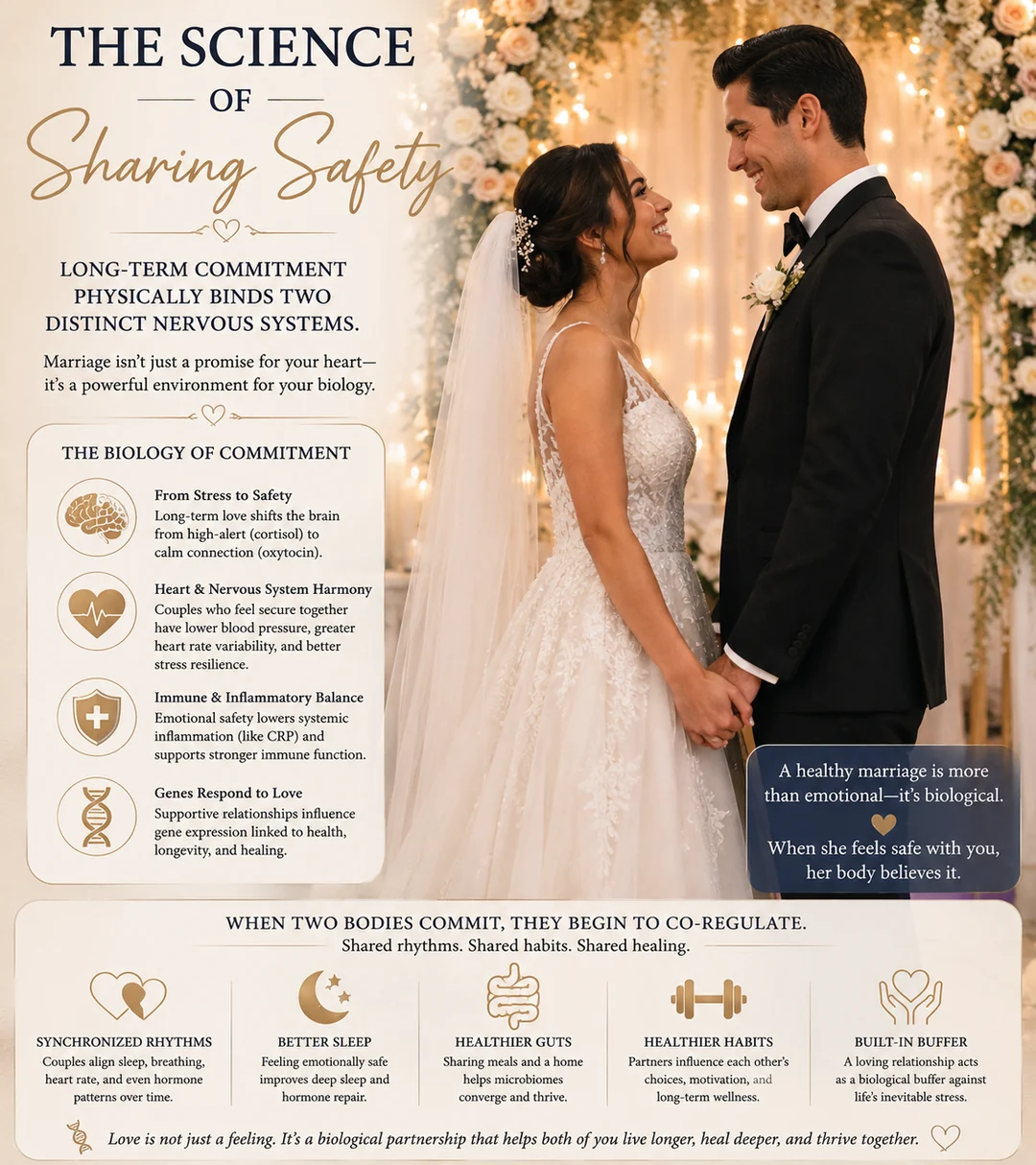
© BloomHer Health 2026 · All Rights Reserved
Marriage is often two nervous systems continuously influencing one another.
Introduction
Beyond the Honeymoon: The Somatic Contract
Marriage is often described as a promise made with the heart.
But from a biological perspective, it is also a relationship that influences the brain, hormones, immune system, metabolism, and nervous system.
Long before scientists understood hormones or neurotransmitters, people recognized that loving relationships seemed to help individuals live longer, recover from illness more successfully, and weather life's storms with greater resilience.
Today, modern neuroscience and psychoneuroimmunology are helping explain why.
A healthy, supportive marriage does more than provide companionship.
It creates an environment of biological safety.
When a woman consistently experiences emotional security, trust, affection, and mutual support, her body receives thousands of subtle signals each day that the environment is safe.
Those signals influence stress hormones, sleep quality, immune regulation, cardiovascular health, and even daily habits that shape long-term wellness.
This does not mean marriage itself automatically improves health.
A high-conflict, emotionally unsafe, or abusive relationship can have the opposite effect.
The quality of the relationship matters far more than marital status alone.
At BloomHer, we believe relationships are part of a woman's health ecosystem.
The people closest to us influence not only our emotions, but also many of the biological systems that help us thrive.
Your Brain Was Designed for Secure Attachment
Human beings are wired for connection.
From infancy through older adulthood, supportive relationships help regulate stress and promote emotional stability.
Neuroscientists describe this process as attachment.
When we consistently experience safety with another person, the brain begins predicting that their presence represents protection rather than danger.
Over time, this creates what researchers call co-regulation.
A supportive spouse may help calm your nervous system simply through everyday interactions:
- •A reassuring conversation.
- •Holding your hand.
- •Sitting together after a difficult day.
- •A warm embrace.
- •Shared laughter.
- •Praying together.
- •Quiet companionship.
These ordinary moments repeatedly reinforce the message:
"You are safe."
Repeated experiences of safety help reduce unnecessary activation of the body's stress response.
From Excitement to Stability
Early romantic relationships often feel exhilarating.
During this stage, the brain is heavily influenced by reward pathways involving dopamine and norepinephrine.
Many couples experience:
- •Excitement
- •Anticipation
- •Intense focus on one another
- •Increased motivation
- •Strong emotional highs
As healthy relationships mature, the emotional experience often changes.
Rather than constant excitement, couples frequently describe feeling:
- •Comfortable
- •Secure
- •Peaceful
- •Grounded
- •Emotionally safe
This shift is not evidence that love has disappeared.
Instead, many researchers believe stable attachment relies more heavily on systems involving oxytocin and vasopressin, neuropeptides that support bonding, trust, and long-term attachment.
Oxytocin is released during many forms of positive social connection, including affectionate touch, childbirth, breastfeeding, and supportive interpersonal interactions.
Although oxytocin is only one piece of a much larger biological picture, it appears to play an important role in reinforcing close relationships.
Safety Changes Physiology
The nervous system constantly evaluates one question:
"Am I safe?"
When the answer is yes, the body more easily shifts into the parasympathetic nervous system, sometimes called the "rest, digest, and repair" state.
This state supports:
- •Healthy digestion
- •Tissue repair
- •Immune regulation
- •Restorative sleep
- •Emotional resilience
- •Balanced stress responses
When relationships become chronically hostile or unpredictable, the opposite may occur.
Repeated conflict may contribute to prolonged activation of the body's stress response, increasing cortisol and making it more difficult to achieve restorative recovery.
Not every disagreement is harmful.
Healthy couples disagree.
What matters is whether conflict is resolved with respect, emotional safety, and mutual care.
Two Nervous Systems Living Together
One fascinating area of relationship science examines physiological synchrony.
Couples who spend years living together often begin sharing similar daily rhythms.
They may gradually synchronize:
- •Sleep schedules
- •Meal timing
- •Activity patterns
- •Stress responses
- •Emotional cues
Researchers continue exploring how close relationships influence heart rate variability, breathing patterns, and emotional regulation.
Although couples do not literally become biologically identical, healthy co-regulation may help improve resilience during stressful periods.
This reminds us that marriage is not simply two people sharing a home.
It is often two nervous systems continuously influencing one another.
The BloomHer Perspective
A healthy marriage is not medicine.
But a supportive relationship can become one of the most powerful environments for lifelong health.
Feeling emotionally safe does not eliminate life's challenges.
It changes how the body responds to them.
Every encouraging word.
Every shared meal.
Every comforting hug.
Every prayer together.
These moments become part of the biology of healing.
In the next section, we'll explore how marriage influences daily habits, metabolism, gut health, inflammation, sleep, and why the quality of your relationship may affect your long-term health just as much as many lifestyle choices.
Step Into Your Bloom
The emotional safety you build in your closest relationships is not separate from your physical health, it shapes your stress, your sleep, your immunity, and your resilience every single day. Whether you are nurturing a strong marriage or rebuilding your sense of safety after a hard season, BloomHer can help you support the body and nervous system underneath it all. Book a private 1-on-1 BloomHer consultation with me today.
Research and References
Curated sources for further reading. Educational only, not medical advice.
- Holt-Lunstad J, Smith TB, Layton JB. Social Relationships and Mortality Risk: A Meta-analytic Review. PLoS Medicine.
- Robles TF, Slatcher RB, Trombello JM, McGinn MM. Marital Quality and Health: A Meta-analytic Review. Psychological Bulletin.
- Carter CS. Oxytocin Pathways and the Evolution of Human Behavior. Annual Review of Psychology.
- American Heart Association. Stress, Relationships, and Cardiovascular Health.
- National Institutes of Health. Social Relationships and Health Research.
- Coan JA, Schaefer HS, Davidson RJ. Lending a Hand: Social Regulation of the Neural Response to Threat. Psychological Science.
- Kiecolt-Glaser JK, Wilson SJ. Lovesick: How Couples' Relationships Influence Health. Nature Reviews Immunology.
- The Gottman Institute. Research on Healthy Relationship Behaviors and Long-Term Marital Stability.

About the Author
Angel Laurent, M.Ed.
Angel Laurent is a certified Holistic Health Practitioner, neuro-coach, and founder of BloomHer.health. With a Master's in Education and advanced training in neuroscience and metabolic health, she has dedicated her career to dismantling the "one-size-fits-all" approach to women's wellness, and is the creator of the Let Her Bloom Series and The Ateliers for Women's Health curriculum.
Through high-touch, one-on-one partnerships, her work centers on five pillars of modern women's wellness:
- •Neuro-Somatic Regulation: Chronic burnout, nervous system dysregulation, and the psychological "saboteurs" that stall well-being.
- •Metabolic Optimization: Restoring cellular energy, balancing blood sugar, and reversing insulin resistance behind stubborn weight gain and fatigue.
- •Endocrine & Hormone Synergy: Perimenopause, menopause, and hormonal transitions through evidence-based, holistic interventions.
- •Gut-Brain Axis Restoration: Healing the gut microbiome to enhance cognitive clarity, mood stability, and immune resilience.
- •Epigenetic Lifestyle Design: Bespoke lifestyle protocols to reclaim vitality, executive function, and physical longevity.
Have a question, or want to work with Angel? Reach her at hello@bloomher.health.
Every Woman. At Every Age. The BloomHer Way.
Don't miss a post
Get new insights from Angel Laurent delivered straight to your inbox.
No spam. Unsubscribe anytime.
