Journal · Faith & Wellness
Faith & WellnessThe Immunology of Hope: How Faith, Purpose, and Spiritual Community Support the Brain, Immune System, and Whole-Body Health
By Angel Laurent · June 2026 · 9 min read
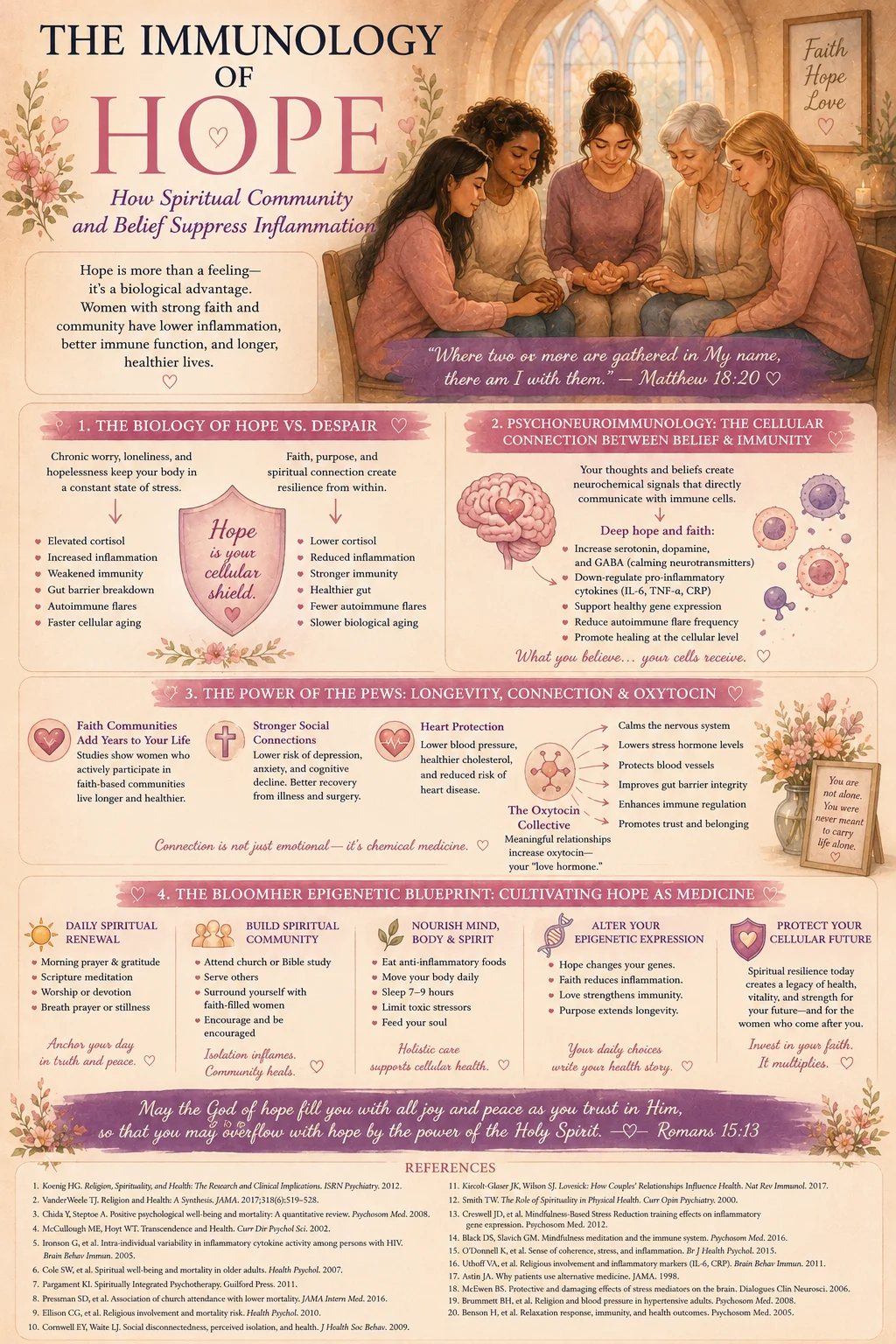
© BloomHer Health 2026 · All Rights Reserved
Hope is not wishful thinking. It is a deeply rooted expectation that God remains faithful even when circumstances feel uncertain.
Introduction
The Biology of Hope vs. Despair
Hope is often thought of as an emotion.
The Bible describes it as an anchor for the soul.
Science is beginning to recognize that hope may also influence the body in remarkable ways.
Every day, millions of women quietly carry invisible burdens.
They worry about aging parents.
They pray for prodigal children.
They wait for biopsy results.
They navigate autoimmune diseases, financial stress, marriage struggles, grief, loneliness, and uncertainty.
Over time, chronic emotional stress can become chronic biological stress.
The body responds by activating the nervous system's survival pathways.
Stress hormones remain elevated.
Sleep becomes lighter.
Inflammation may increase.
Energy begins to fade.
Many women believe this is simply part of getting older.
But the body was never designed to live in a constant state of fear.
At BloomHer, we believe one of the greatest gifts God gave us is hope.
Hope is not wishful thinking.
It is a deeply rooted expectation that God remains faithful even when circumstances feel uncertain.
That expectation changes more than perspective.
It may influence how the brain interprets stress.
And when the brain interprets less danger, the body often responds differently.
The Conversation Between the Brain and the Immune System
For many years, scientists believed the brain and immune system functioned independently.
Today we know they are in constant communication.
This field of study is called psychoneuroimmunology.
It explores how thoughts, emotions, relationships, stress, and behavior influence immune function.
When we experience chronic stress, the brain activates the hypothalamic-pituitary-adrenal (HPA) axis.
Stress hormones such as cortisol and adrenaline prepare the body for survival.
In the short term, this response is protective.
When prolonged, however, it may contribute to immune dysregulation, poor sleep, fatigue, and persistent inflammation.
Researchers have also observed that chronic loneliness, hopelessness, and social isolation are associated with higher rates of cardiovascular disease, depression, and poorer overall health.
Hope appears to work differently.
Although hope cannot eliminate life's hardships, it may change how the brain responds to them.
Women who cultivate optimism, purpose, and meaningful relationships often demonstrate greater resilience during difficult seasons.
Their challenges remain real.
Their nervous systems simply become better equipped to recover.
Faith Changes More Than Feelings
Faith is not merely believing something intellectually.
Biblical faith invites us to entrust our fears, burdens, and future to God.
Scripture reminds us:
Casting all your care upon him; for he careth for you.
1 Peter 5:7
From a psychological perspective, this practice resembles what researchers call adaptive coping, responding to stress in ways that reduce its emotional burden.
For believers, however, prayer is much more than a coping strategy.
It is a relationship.
Every prayer shifts attention away from carrying every burden alone.
Instead of asking,
"How will I survive this?"
Faith gently reframes the question:
"Lord, walk with me through this."
That shift may reduce the perception of threat, allowing the nervous system to move toward a calmer physiological state.
Why Community Matters
God never intended women to carry life alone.
Throughout Scripture we see believers gathering together to worship, pray, encourage one another, and bear one another's burdens.
Modern research echoes this timeless principle.
Women who have meaningful social support generally experience:
- •Better emotional well-being.
- •Greater resilience after illness.
- •Improved recovery following surgery.
- •Lower rates of depression.
- •Better long-term health outcomes.
Faith communities often provide more than friendship.
They offer belonging.
Shared purpose.
Prayer.
Meals during difficult seasons.
Encouragement when hope feels distant.
These relationships may reduce loneliness, one of the strongest predictors of poor health in older adults.
Supportive social connection has also been associated with healthier cardiovascular function and lower overall mortality risk.
Hope Does Not Remove the Storm
Following Christ does not promise a life without hardship.
Illness still happens.
Grief still comes.
Relationships still break.
But hope changes how we walk through those valleys.
The Apostle Paul wrote:
Now the God of hope fill you with all joy and peace in believing, that ye may abound in hope, through the power of the Holy Ghost.
Romans 15:13
Peace does not always change our circumstances immediately.
Sometimes it changes the way our nervous system carries them.
That is one of God's beautiful gifts.
The BloomHer Perspective
Every prayer.
Every Scripture.
Every worship song.
Every encouraging conversation.
Every act of faith.
These are not only moments that nourish the soul.
They may also become moments that support emotional resilience, healthier stress regulation, and whole-person well-being.
At BloomHer, we believe spiritual health and physical health were never meant to compete.
They were designed to walk together.
In the next section, we'll explore the fascinating science behind inflammation, cytokines, social connection, oxytocin, and how daily spiritual practices may help build resilience for both the mind and body.
Step Into Your Bloom
The faith that anchors your soul and the health of your body were never meant to compete, they were designed to walk together. At BloomHer, we help women care for spirit and body as one, building daily rhythms of hope, connection, rest, and nourishment that support resilience through every season. Book a private 1-on-1 BloomHer consultation with me today.
Research and References
Curated sources for further reading. Educational only, not medical advice.
- Koenig HG. Handbook of Religion and Health. Oxford University Press.
- VanderWeele TJ. Religion and Health: A Synthesis. JAMA.
- Slavich GM, Cole SW. The Emerging Field of Human Social Genomics. Clinical Psychological Science.
- Holt-Lunstad J, Smith TB, Layton JB. Social Relationships and Mortality Risk. PLoS Medicine.
- Kiecolt-Glaser JK, Wilson SJ. Lovesick: How Couples' Relationships Influence Health. Nature Reviews Immunology.
- Cole SW. Human Social Genomics. Annual Review of Psychology.
- National Institutes of Health. Psychoneuroimmunology and Health.
- Chida Y, Steptoe A. Positive Psychological Well-Being and Mortality. Psychosomatic Medicine.
- Benson H. The Relaxation Response.
- Porges SW. The Polyvagal Theory.
- American Psychological Association. Stress Effects on the Body.
- Newberg AB, Waldman MR. How God Changes Your Brain.
- Davidson RJ, Goleman D. Altered Traits.
- Harvard Medical School. Mind-Body Medicine.
- Thayer JF, Lane RD. The Role of Vagal Function in Emotional Regulation. Biological Psychology.
- Ironson G, et al. Spirituality and Immune Function Research. Brain, Behavior, and Immunity.
- McCullough ME, Larson DB. Handbook of Religion and Health Outcomes.
- The Holy Bible, King James Version (Romans 15:13; 1 Peter 5:7; Hebrews 6:19; Isaiah 40:31).
- National Institute on Aging. Loneliness and Health.
- World Health Organization. Mental Health, Social Connection, and Well-Being.

About the Author
Angel Laurent, M.Ed.
Angel Laurent is a certified Holistic Health Practitioner, neuro-coach, and founder of BloomHer.health. With a Master's in Education and advanced training in neuroscience and metabolic health, she has dedicated her career to dismantling the "one-size-fits-all" approach to women's wellness, and is the creator of the Let Her Bloom Series and The Ateliers for Women's Health curriculum.
Through high-touch, one-on-one partnerships, her work centers on five pillars of modern women's wellness:
- •Neuro-Somatic Regulation: Chronic burnout, nervous system dysregulation, and the psychological "saboteurs" that stall well-being.
- •Metabolic Optimization: Restoring cellular energy, balancing blood sugar, and reversing insulin resistance behind stubborn weight gain and fatigue.
- •Endocrine & Hormone Synergy: Perimenopause, menopause, and hormonal transitions through evidence-based, holistic interventions.
- •Gut-Brain Axis Restoration: Healing the gut microbiome to enhance cognitive clarity, mood stability, and immune resilience.
- •Epigenetic Lifestyle Design: Bespoke lifestyle protocols to reclaim vitality, executive function, and physical longevity.
Have a question, or want to work with Angel? Reach her at hello@bloomher.health.
Every Woman. At Every Age. The BloomHer Way.
Don't miss a post
Get new insights from Angel Laurent delivered straight to your inbox.
No spam. Unsubscribe anytime.
