Journal · Emotional Health
Emotional HealthThe Invisible Fracture: How Discovering a Partner's Compulsive Pornography Use Affects a Woman's Body
By Angel Laurent · June 2026 · 8 min read
© BloomHer Health 2026 · All Rights Reserved
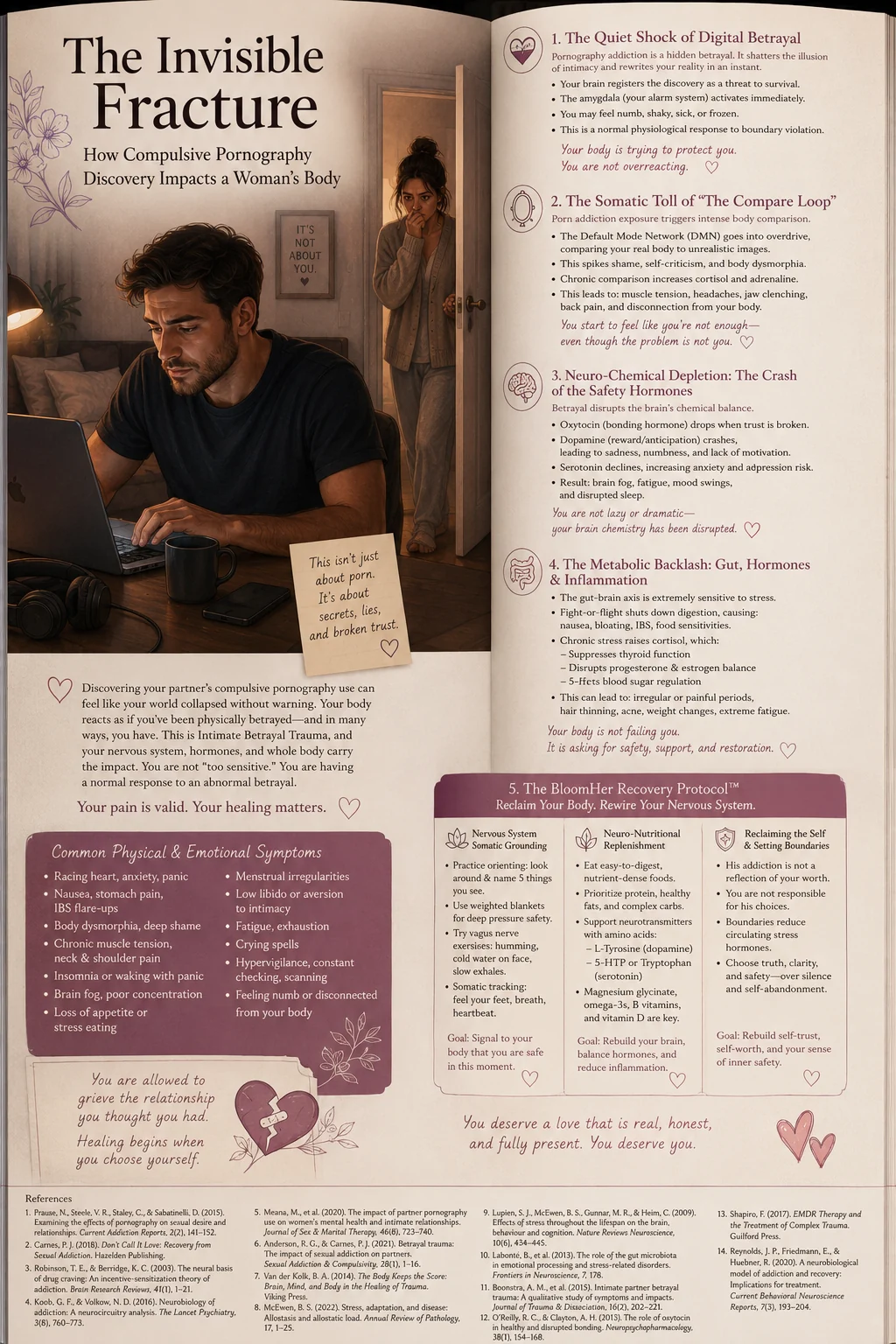
Your body is responding exactly the way a human nervous system was designed to respond when trust is suddenly shattered.
Introduction
The Quiet Shock of Digital Betrayal
There are moments in life that divide everything into two chapters: before and after.
For many women, discovering a partner's secret pornography use is one of those moments.
Perhaps you accidentally found browser history.
Maybe you discovered hidden accounts, deleted messages, or subscriptions.
Maybe your partner finally admitted what had been happening for months, or years.
Whatever the circumstances, the discovery often produces an overwhelming feeling that your reality has suddenly changed.
You begin questioning conversations you once believed.
Memories feel different.
Moments that once represented intimacy now feel uncertain.
Many women describe this experience as if the foundation beneath them suddenly disappeared.
They often ask themselves:
"Was any of it real?"
"Why wasn't I enough?"
"How could I have missed this?"
Those questions are common, but there is something equally important happening beneath them.
Your body has entered survival mode.
The racing heart.
The nausea.
The trembling.
The inability to eat.
The inability to sleep.
The tightness in your chest.
The sudden waves of panic.
These are not signs that you are "too emotional."
They are signs that your nervous system has detected a profound threat to a relationship your brain had identified as a primary source of safety.
Researchers studying betrayal trauma describe these reactions as part of an acute stress response that can occur when a trusted attachment relationship is unexpectedly disrupted. Although each woman's experience is unique, many report symptoms similar to those seen after other highly stressful life events, including intrusive thoughts, hypervigilance, disturbed sleep, and difficulty concentrating.
At BloomHer, we believe healing begins when women understand one simple truth:
Your body is responding exactly the way a human nervous system was designed to respond when trust is suddenly shattered.
Why This Kind of Betrayal Feels Different
Pornography-related betrayal often creates a unique emotional experience.
Unlike a single moment of infidelity, compulsive pornography use may involve repeated secrecy, concealment, and emotional withdrawal over time.
For many women, the pain comes not only from the sexual content itself, but from the realization that intimacy, honesty, and transparency within the relationship have been compromised.
Many describe feeling:
- •Invisible
- •Rejected
- •Replaced
- •Unwanted
- •Confused
- •Deeply alone
These emotions are powerful because intimate relationships are more than emotional experiences.
They are biological attachment systems.
Healthy attachment relationships help regulate stress, support emotional stability, and contribute to a sense of safety.
When that safety is suddenly questioned, the brain begins scanning for danger.
Your Brain Immediately Searches for Answers
Within moments of discovering a significant betrayal, the brain begins gathering information.
Questions race through your mind.
"How long has this been happening?"
"Was I ever enough?"
"Can I trust anything anymore?"
This constant search for answers is not weakness.
It reflects the brain's attempt to restore predictability after an unexpected shock.
The amygdala, your brain's threat detection center, becomes highly active.
Meanwhile, areas involved in planning, reasoning, and emotional regulation may become less efficient under intense stress.
This explains why many women experience:
- •Racing thoughts
- •Difficulty focusing
- •Trouble making decisions
- •Intrusive mental images
- •Hypervigilance
- •Repeated checking behaviors
- •Feeling emotionally overwhelmed
Your nervous system is trying to protect you by preventing another surprise.
Unfortunately, remaining in this heightened state for weeks or months becomes exhausting.
The "Compare Loop"
One of the most painful experiences many women describe after discovering compulsive pornography use is constant comparison.
The mind begins asking:
"Do I look like them?"
"Am I attractive enough?"
"Would he choose me if I looked different?"
"What's wrong with my body?"
This mental habit, sometimes called the compare loop, can become relentless.
Social media, advertisements, and digitally altered images may intensify these thoughts.
Over time, chronic self-comparison can contribute to body dissatisfaction, reduced self-esteem, and emotional distress.
For some women, these thoughts become so frequent that they begin changing how they dress, exercise, eat, or interact with their partner.
It is important to remember that these reactions do not prove there is something wrong with your body.
They often reflect the brain's attempt to explain painful experiences by searching for something it believes it can control.
Unfortunately, self-blame rarely leads to healing.
When Shame Becomes Physical
Emotional pain rarely stays confined to the mind.
The body often carries it as well.
Women navigating betrayal frequently report:
- •Tight shoulders
- •Neck pain
- •Jaw clenching
- •Headaches
- •Stomach discomfort
- •Fatigue
- •Tearfulness
- •Difficulty taking deep breaths
Stress hormones such as cortisol and adrenaline increase during acute emotional stress.
Muscles tighten.
Breathing becomes shallower.
Sleep becomes fragmented.
The digestive system slows.
The entire body shifts into protection mode.
Healing therefore requires more than simply changing thoughts.
The nervous system must gradually learn that it is safe again.
In the next section, we'll explore how betrayal influences oxytocin, dopamine, sleep, and the gut-brain axis, and why many women experience brain fog, exhaustion, appetite changes, and hormonal disruption after prolonged relational stress.
Step Into Your Bloom
If discovering a partner's compulsive pornography use has left you anxious, exhausted, and questioning your own worth, please hear this: his choices are not a reflection of your value, and your body's reaction is not weakness. BloomHer helps women calm the nervous system, quiet the compare loop, and rebuild self-trust and physical health after intimate betrayal. Book a private 1-on-1 BloomHer consultation with me today.

About the Author
Angel Laurent, M.Ed.
Angel Laurent is a certified Holistic Health Practitioner, neuro-coach, and founder of BloomHer.health. With a Master's in Education and advanced training in neuroscience and metabolic health, she has dedicated her career to dismantling the "one-size-fits-all" approach to women's wellness, and is the creator of the Let Her Bloom Series and The Ateliers for Women's Health curriculum.
Through high-touch, one-on-one partnerships, her work centers on five pillars of modern women's wellness:
- •Neuro-Somatic Regulation: Chronic burnout, nervous system dysregulation, and the psychological "saboteurs" that stall well-being.
- •Metabolic Optimization: Restoring cellular energy, balancing blood sugar, and reversing insulin resistance behind stubborn weight gain and fatigue.
- •Endocrine & Hormone Synergy: Perimenopause, menopause, and hormonal transitions through evidence-based, holistic interventions.
- •Gut-Brain Axis Restoration: Healing the gut microbiome to enhance cognitive clarity, mood stability, and immune resilience.
- •Epigenetic Lifestyle Design: Bespoke lifestyle protocols to reclaim vitality, executive function, and physical longevity.
Have a question, or want to work with Angel? Reach her at hello@bloomher.health.
Every Woman. At Every Age. The BloomHer Way.
Don't miss a post
Get new insights from Angel Laurent delivered straight to your inbox.
No spam. Unsubscribe anytime.
