Journal · Emotional Health
Emotional HealthThe Marriage Paradox: When a Relationship Becomes Your Greatest Medicine, or Your Greatest Stressor
By Angel Laurent · June 2026 · 9 min read
© BloomHer Health 2026 · All Rights Reserved
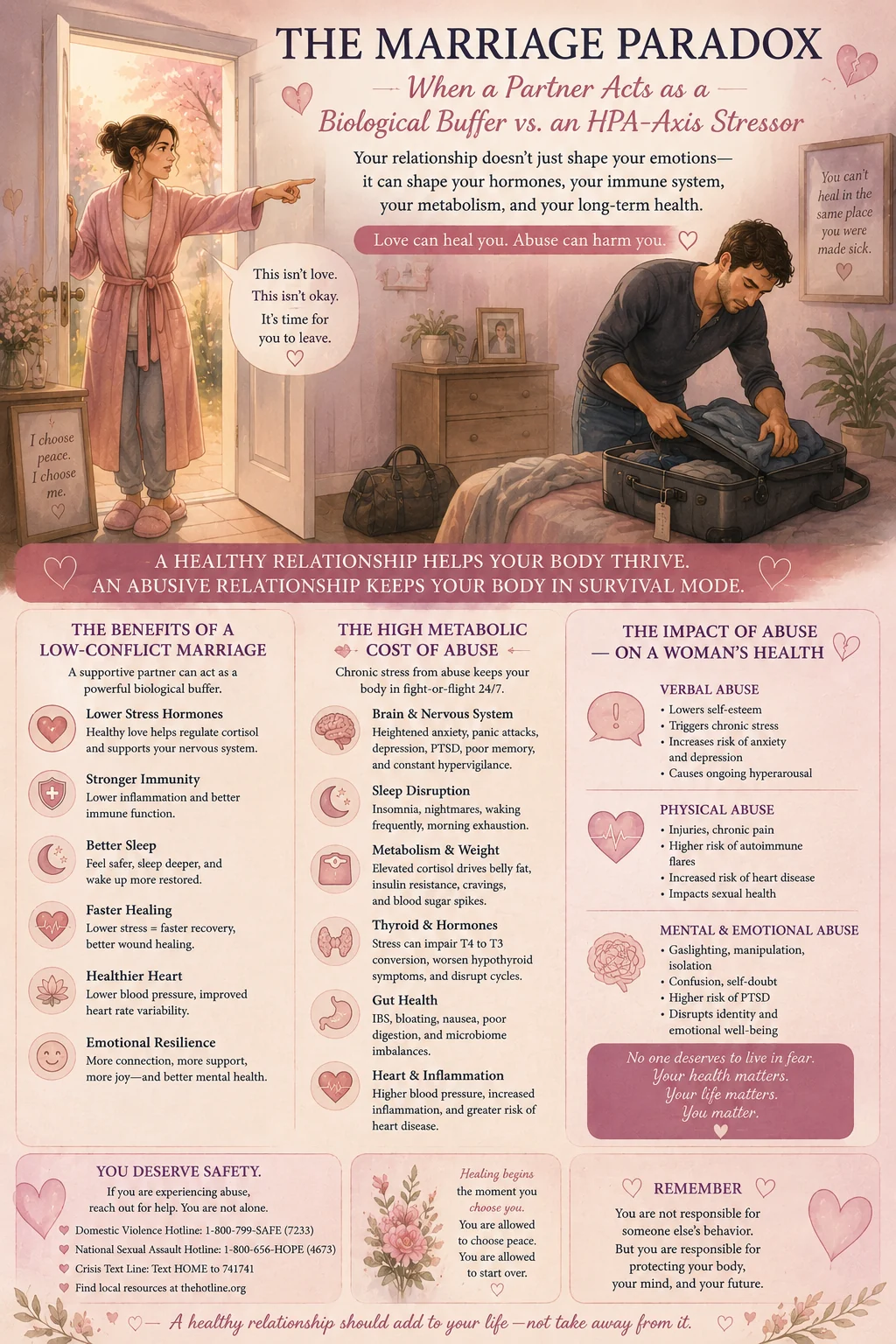
Your nervous system never lies. It knows the difference between peace and survival.
Introduction
Not Every Marriage Is Good for Your Health
People often say,
"Marriage is good for you."
The truth is more complicated.
A healthy marriage can become one of the greatest protective factors for a woman's physical and emotional health.
An unhealthy marriage can become one of the greatest chronic stressors her body will ever experience.
Your body does not respond to a marriage certificate.
It responds to the environment you live in every day.
Does your home feel peaceful?
Or unpredictable?
Do you feel emotionally safe?
Or constantly anxious?
Do you sleep beside someone who comforts you...
...or someone you fear?
Those answers matter biologically.
At BloomHer, we often say:
Your nervous system never lies.
It knows the difference between peace and survival.
Your Body Was Never Designed to Live in Constant Survival Mode
Every human nervous system is designed to respond to danger.
When genuine danger appears, your brain immediately activates the Hypothalamic-Pituitary-Adrenal (HPA) axis, releasing stress hormones such as cortisol and adrenaline.
In a short-term emergency, these hormones are lifesaving.
They increase alertness.
Raise heart rate.
Increase available energy.
Help you react quickly.
Once the danger passes, cortisol should gradually return toward baseline.
Your body repairs itself.
Inflammation settles.
Digestion resumes.
Sleep improves.
Healing begins.
The problem develops when the danger never seems to end.
For women living in chronically high-conflict or abusive relationships, the nervous system may remain activated far longer than it was designed to.
Whether the abuse is physical, emotional, verbal, psychological, sexual, or coercive, living in a state of ongoing fear or unpredictability can have profound effects on health.
The Body Keeps Listening
Many women living in abusive relationships describe feeling exhausted all the time.
They may believe they are simply "stressed."
Their bodies may be telling a much larger story.
Research has found that women experiencing intimate partner violence have higher rates of:
- •Chronic anxiety
- •Depression
- •Post-traumatic stress disorder (PTSD)
- •Chronic pain
- •Migraine headaches
- •Gastrointestinal disorders
- •Sleep disturbances
- •High blood pressure
- •Cardiovascular disease risk
- •Substance use disorders
Some women also report worsening autoimmune symptoms, increased fatigue, changes in appetite, menstrual irregularities, or difficulty managing chronic medical conditions during prolonged periods of severe stress.
Although many factors influence these conditions, chronic activation of the body's stress response may contribute to worsening symptoms.
Sleep Is Often the First Casualty
One of the earliest biological changes many women notice is disrupted sleep.
Instead of entering restorative deep sleep, the brain continues scanning for danger.
Even after falling asleep, many women report:
- •Waking suddenly
- •Sleeping lightly
- •Nightmares
- •Difficulty returning to sleep
- •Morning exhaustion
Without consistent restorative sleep, the body has fewer opportunities to:
- •Repair tissues
- •Regulate immune function
- •Balance hormones
- •Consolidate memories
- •Recover emotionally
This creates a cycle in which fatigue increases emotional vulnerability, making everyday stress feel even harder to manage.
The Hidden Metabolic Cost
Stress hormones influence nearly every organ system.
When cortisol remains elevated for long periods, researchers have observed associations with:
- •Increased appetite in some individuals
- •Greater abdominal fat accumulation
- •Less favorable blood sugar regulation
- •Reduced motivation for physical activity
- •Higher blood pressure
- •Persistent inflammation
Chronic stress may also influence thyroid hormone metabolism and can worsen symptoms in women who already have thyroid disease.
No single laboratory value can diagnose stress.
But your body often reflects the burden it has been carrying.
Abuse Is Never a Health Plan
Some women stay because they hope things will improve.
Some stay because they are financially dependent.
Some stay because they fear retaliation.
Some stay because children are involved.
Some stay because they have been convinced they deserve no better.
Whatever the reason, it is important to say this clearly:
No one deserves abuse.
If you are living with physical violence, threats, coercive control, or escalating danger, your safety comes first.
Seeking help is not weakness.
It is a step toward protecting both your life and your health.
Leaving an abusive relationship can be complex and sometimes dangerous. Whenever possible, create a safety plan with trusted family members, friends, advocates, or local domestic violence services before making major decisions.
The BloomHer Perspective
A healthy relationship helps your body breathe.
An abusive relationship teaches your body to brace.
One environment supports healing.
The other demands survival.
Your body keeps score, not to punish you, but to protect you.
And every woman deserves a home where her nervous system can finally hear the words:
"You are safe."
Step Into Your Bloom
If any part of this describes your relationship, please know that your safety comes first and you are not alone. In the United States, you can reach the National Domestic Violence Hotline confidentially, any time, at 1-800-799-7233, or text START to 88788. When you are safe, BloomHer is here to help you rebuild what chronic stress took from you, your sleep, your hormones, your nervous system, and your strength. You deserve a home where your body can finally rest.
Research and References
Curated sources for further reading. Educational only, not medical advice.
- World Health Organization. Violence Against Women: Health Consequences.
- Centers for Disease Control and Prevention. Preventing Intimate Partner Violence.
- Campbell JC. Health Consequences of Intimate Partner Violence. The Lancet.
- Coker AL, et al. Physical and Mental Health Effects of Intimate Partner Violence. American Journal of Preventive Medicine.
- Kiecolt-Glaser JK, Wilson SJ. Lovesick: How Couples' Relationships Influence Health. Nature Reviews Immunology.
- Robles TF, Slatcher RB, Trombello JM, McGinn MM. Marital Quality and Health: A Meta-Analytic Review. Psychological Bulletin.
- American Psychological Association. Stress Effects on the Body.
- National Institute of Mental Health. Post-Traumatic Stress Disorder.
- American Heart Association. Stress and Cardiovascular Disease.
- National Domestic Violence Hotline. The Impact of Abuse on Physical and Mental Health.
About the Author
Angel Laurent, M.Ed.
Angel Laurent is a certified Holistic Health Practitioner, neuro-coach, and founder of BloomHer.health. With a Master's in Education and advanced training in neuroscience and metabolic health, she has dedicated her career to dismantling the "one-size-fits-all" approach to women's wellness, and is the creator of the Let Her Bloom Series and The Ateliers for Women's Health curriculum.
Through high-touch, one-on-one partnerships, her work centers on five pillars of modern women's wellness:
- •Neuro-Somatic Regulation: Chronic burnout, nervous system dysregulation, and the psychological "saboteurs" that stall well-being.
- •Metabolic Optimization: Restoring cellular energy, balancing blood sugar, and reversing insulin resistance behind stubborn weight gain and fatigue.
- •Endocrine & Hormone Synergy: Perimenopause, menopause, and hormonal transitions through evidence-based, holistic interventions.
- •Gut-Brain Axis Restoration: Healing the gut microbiome to enhance cognitive clarity, mood stability, and immune resilience.
- •Epigenetic Lifestyle Design: Bespoke lifestyle protocols to reclaim vitality, executive function, and physical longevity.
Have a question, or want to work with Angel? Reach her at hello@bloomher.health.
Every Woman. At Every Age. The BloomHer Way.
Don't miss a post
Get new insights from Angel Laurent delivered straight to your inbox.
No spam. Unsubscribe anytime.
