Journal · Faith & Wellness
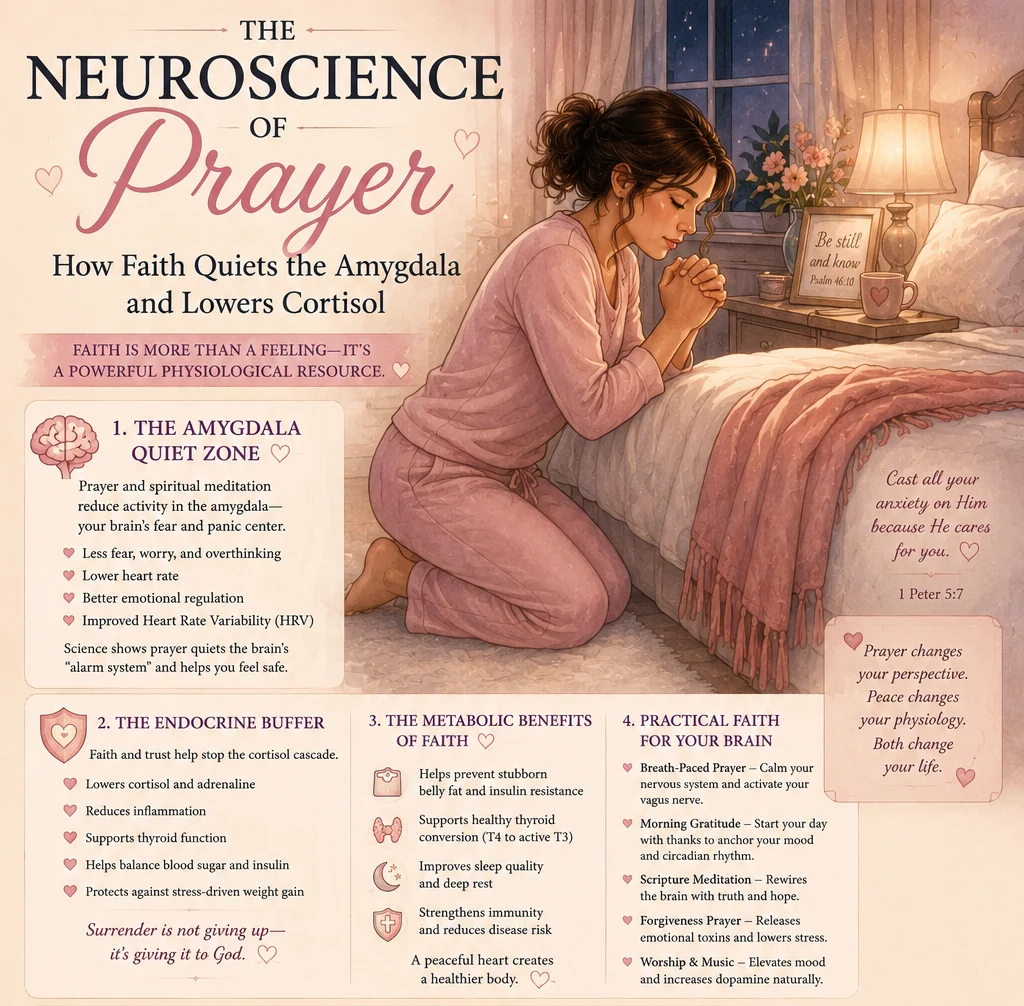
Faith & WellnessThe Neuroscience of Prayer: How Faith May Calm the Brain, Quiet Fear, and Support Whole-Body Health
By Angel Laurent · June 2026 · 8 min read
© BloomHer Health 2026 · All Rights Reserved
Faith is not merely something you believe. It is something you practice.
Introduction
Faith Is More Than a Feeling
When life becomes overwhelming, many women instinctively do one thing.
They pray.
Some whisper prayers while driving.
Some pray while folding laundry.
Some kneel beside their bed.
Others simply close their eyes and whisper,
"Lord...I need You."
For thousands of years, people have believed prayer brings peace to the soul.
Today, neuroscience is beginning to explore something equally remarkable:
Prayer may also influence the brain and body.
That does not mean prayer replaces medical care.
Nor does it mean every health problem disappears because we have faith.
Instead, research suggests that regular contemplative practices, including prayer, gratitude, worship, and meditation, may help regulate the nervous system, reduce perceived stress, improve emotional resilience, and support healthier physiological responses.
At BloomHer, we believe a woman's spiritual environment is every bit as important as her physical environment.
Because the body constantly asks one question:
"Am I safe?"
Faith has the potential to change how that question is answered.
Your Brain Has a Built-In Alarm System
Deep inside your brain is a small almond-shaped structure called the amygdala.
Think of it as your internal smoke detector.
Its job is simple:
Detect danger.
Protect you.
React quickly.
When genuine danger appears, the amygdala is lifesaving.
It increases alertness.
Raises heart rate.
Activates stress hormones.
Prepares your body for action.
The problem arises when the brain begins treating everyday worries as emergencies.
Bills.
Medical tests.
Family conflict.
Financial uncertainty.
Waiting for biopsy results.
Caring for aging parents.
Raising children.
The amygdala doesn't always distinguish between a physical threat and an emotional one.
Over time, chronic stress may leave the nervous system feeling as though danger is everywhere.
What Happens During Prayer?
Researchers using functional brain imaging have explored what occurs during various forms of contemplative prayer and meditation.
Although different traditions practice differently, several consistent themes have emerged.
Many studies suggest that focused prayer and contemplative practices are associated with:
- •Reduced activity in brain regions involved in rumination and self-focused worry.
- •Improved activation of areas involved in attention and emotional regulation.
- •Greater feelings of calm and connection.
- •Reduced perceived stress.
- •Improved resilience during adversity.
Prayer is not simply "positive thinking."
For many believers, prayer shifts attention away from carrying every burden alone and toward trusting God with what cannot be controlled.
That change in perspective may influence how the brain interprets stress.
Surrender Changes the Conversation
One of the central themes throughout Scripture is trust.
Jesus reminds us:
Come unto me, all ye that labour and are heavy laden, and I will give you rest.
Matthew 11:28
When a woman truly believes she does not have to carry every burden by herself, something profound often changes.
Her breathing slows.
Her shoulders relax.
Her thoughts become less frantic.
She is no longer fighting every battle alone.
Modern psychology refers to this as cognitive reappraisal, changing how we interpret difficult situations.
Faith offers something even deeper.
It offers relationship.
Instead of saying,
"I have to fix everything."
Prayer gently changes the conversation to:
"Lord, walk with me through this."
That subtle shift may reduce the perception of threat, helping the nervous system move toward a calmer physiological state.
Why Peace Matters to Your Body
When the brain perceives less danger, the body often responds accordingly.
Many women notice that after heartfelt prayer they experience:
- •Slower breathing.
- •Reduced muscle tension.
- •A quieter mind.
- •Improved emotional clarity.
- •Greater hope.
- •Better ability to cope with uncertainty.
Researchers continue studying how these experiences relate to heart rate variability (HRV), stress hormone regulation, sleep, and emotional resilience.
Although prayer is not a substitute for appropriate medical treatment, cultivating spiritual practices may become one important part of a comprehensive approach to whole-person health.
The BloomHer Perspective
Faith is not merely something you believe.
It is something you practice.
Every whispered prayer.
Every Psalm read aloud.
Every moment of gratitude.
Every sunrise spent with God.
Every act of surrender.
These moments become repeated invitations for your body to hear one life-changing message:
"You are not alone."
At BloomHer, we believe healing begins when the mind, body, and spirit move toward peace together.
In the next section, we'll explore how prayer, gratitude, breathing, and worship influence stress hormones, sleep, heart rate variability, and practical daily habits that support both spiritual and physical well-being.
Step Into Your Bloom
Your spiritual life and your physical health are not separate, they were always meant to heal together. At BloomHer, we walk with women who want to care for mind, body, and spirit as one, building daily rhythms of prayer, rest, and nourishment that help the whole person flourish. Book a private 1-on-1 BloomHer consultation with me today.
Research and References
Curated sources for further reading. Educational only, not medical advice.
- Newberg AB, Waldman MR. How God Changes Your Brain.
- Newberg AB, d'Aquili EG. Why God Won't Go Away: Brain Science and the Biology of Belief.
- Koenig HG. Handbook of Religion and Health. Oxford University Press.
- VanderWeele TJ. Religion and Health: A Synthesis. JAMA.
- Benson H. The Relaxation Response.
- National Center for Complementary and Integrative Health. Meditation and Mindfulness.
- American Psychological Association. Stress Effects on the Body.
- Davidson RJ, Goleman D. Altered Traits.
- Thayer JF, Lane RD. The Role of Vagal Function in Emotional Regulation. Biological Psychology.
- Porges SW. The Polyvagal Theory.
- Harvard Medical School. Mind-Body Medicine and Stress Reduction.
- The Holy Bible, King James Version (Matthew 11:28; Philippians 4:6-7; Isaiah 26:3).

About the Author
Angel Laurent, M.Ed.
Angel Laurent is a certified Holistic Health Practitioner, neuro-coach, and founder of BloomHer.health. With a Master's in Education and advanced training in neuroscience and metabolic health, she has dedicated her career to dismantling the "one-size-fits-all" approach to women's wellness, and is the creator of the Let Her Bloom Series and The Ateliers for Women's Health curriculum.
Through high-touch, one-on-one partnerships, her work centers on five pillars of modern women's wellness:
- •Neuro-Somatic Regulation: Chronic burnout, nervous system dysregulation, and the psychological "saboteurs" that stall well-being.
- •Metabolic Optimization: Restoring cellular energy, balancing blood sugar, and reversing insulin resistance behind stubborn weight gain and fatigue.
- •Endocrine & Hormone Synergy: Perimenopause, menopause, and hormonal transitions through evidence-based, holistic interventions.
- •Gut-Brain Axis Restoration: Healing the gut microbiome to enhance cognitive clarity, mood stability, and immune resilience.
- •Epigenetic Lifestyle Design: Bespoke lifestyle protocols to reclaim vitality, executive function, and physical longevity.
Have a question, or want to work with Angel? Reach her at hello@bloomher.health.
Every Woman. At Every Age. The BloomHer Way.
Don't miss a post
Get new insights from Angel Laurent delivered straight to your inbox.
No spam. Unsubscribe anytime.
