Journal · Emotional Health
Emotional HealthThe Widowhood Effect: The Neuro-Metabolic and Cardiovascular Cost of Losing a Life Partner
By Angel Laurent · June 2026 · 8 min read
© BloomHer Health 2026 · All Rights Reserved
Your body is not failing you. It is trying to survive one of life's deepest losses.
Introduction
The Biological Cost of a Shattered Bond
There are losses in life that change everything.
Losing a spouse after decades of marriage is one of them.
The person who shared your morning coffee, your evening conversations, your holidays, your routines, your laughter, and your quiet moments is suddenly gone.
The silence can feel overwhelming.
Many widows describe waking up expecting to hear their husband's voice before remembering he is no longer there. Others instinctively reach across the bed during the night, only to find an empty pillow. The absence is not only emotional, it is physical.
Family and friends often say, "Take one day at a time."
While those words are well intentioned, they rarely explain why your body suddenly feels as though it no longer belongs to you.
Your heart races without warning.
You feel exhausted even after sleeping.
Food no longer tastes the same.
Simple tasks become overwhelming.
You forget appointments and lose your train of thought.
Your chest aches.
Your muscles feel weak.
You may wonder whether grief alone can truly make you physically ill.
Modern research suggests the answer is yes.
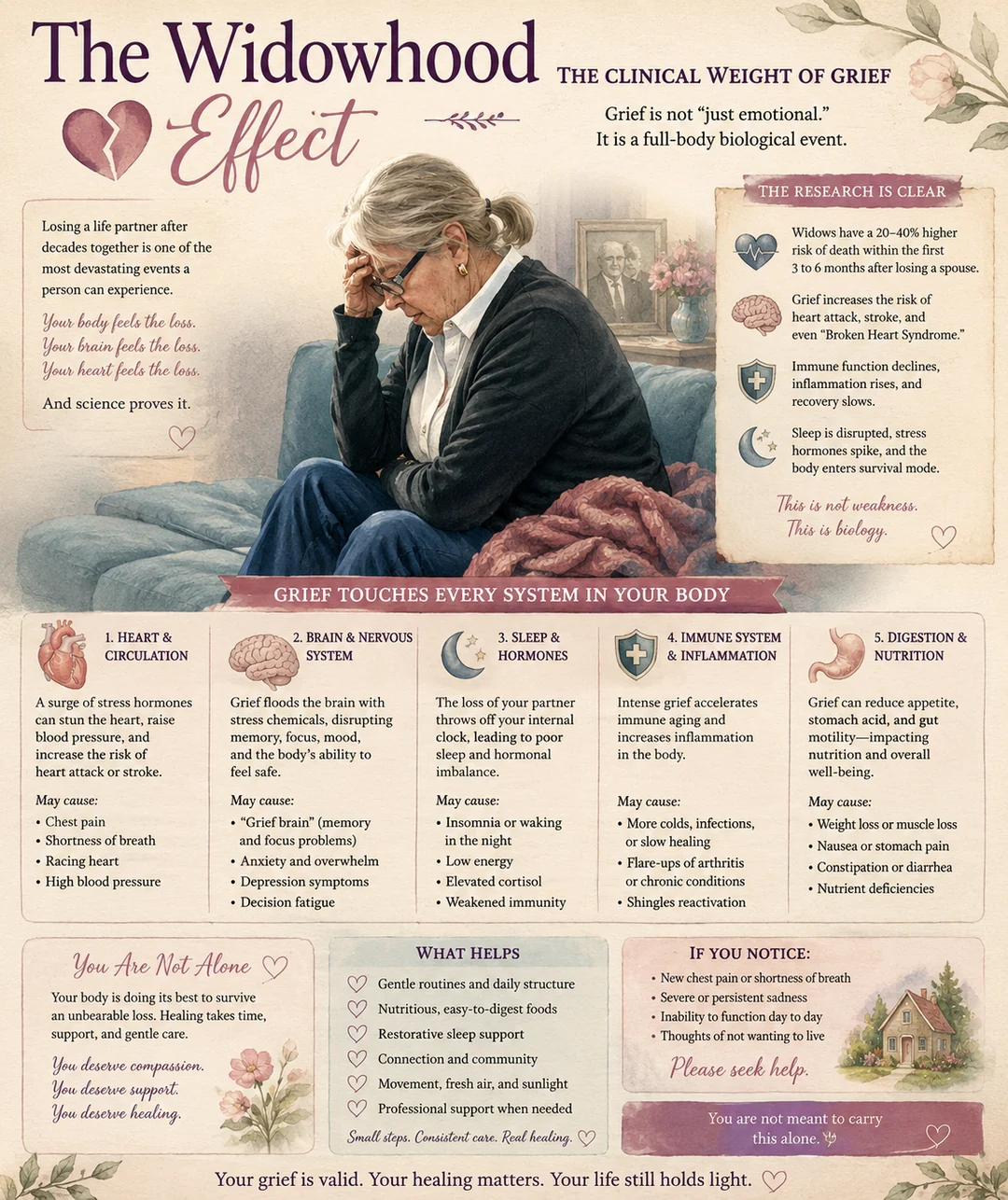
Scientists have documented what is commonly known as the widowhood effect, an increased risk of illness and death among surviving spouses, particularly during the first several months after bereavement. While every person's experience is unique, intense grief has been associated with higher rates of cardiovascular events, sleep disruption, immune changes, depression, and functional decline, especially in older adults.
This does not mean that every widow will become seriously ill.
It means your body is responding to one of the most profound stressors a human being can experience.
At BloomHer, we believe understanding these biological changes removes unnecessary guilt and helps women recognize that healing requires caring for both the heart and the body.
Why the Brain Experiences Grief as a Survival Threat
Human beings are biologically designed for attachment.
Long-term relationships become deeply integrated into everyday life.
Your spouse often becomes part of your daily rhythm.
You wake together.
Eat together.
Talk together.
Solve problems together.
Over years, your brain begins recognizing that person as part of your internal sense of safety.
Neuroscientists sometimes describe this as co-regulation.
Simply hearing a familiar voice, holding a loved one's hand, or sharing a routine can reduce stress hormones and promote feelings of calm.
When that person dies, the nervous system loses one of its primary sources of stability.
The brain suddenly receives conflicting information.
One part knows your spouse has died.
Another part continues expecting them to walk through the door.
This mismatch creates profound stress.
For many widows, ordinary experiences become painful reminders:
- •Setting one plate instead of two.
- •Sleeping alone.
- •Walking into an empty home.
- •Celebrating holidays without them.
- •Hearing their favorite song.
- •Smelling their cologne.
- •Visiting familiar places.
Each reminder activates emotional and physiological responses because the brain is slowly learning a completely new reality.
This process takes time.
The Stress Response Begins Immediately
The moment the brain perceives overwhelming emotional danger, it activates the body's stress response.
The hypothalamus signals the pituitary gland.
The pituitary signals the adrenal glands.
Stress hormones, including adrenaline and cortisol, are released into the bloodstream.
These hormones serve an important purpose during emergencies.
They:
- •Increase heart rate.
- •Raise blood pressure.
- •Mobilize glucose for energy.
- •Heighten awareness.
- •Prepare the body for action.
During brief emergencies, this response is protective.
Bereavement, however, is rarely brief.
The stress response may remain elevated for weeks or months while the mind and body gradually adapt to an entirely new life.
This prolonged activation contributes to many of the physical symptoms widows describe:
- •Trembling.
- •Fatigue.
- •Poor concentration.
- •Sleep disruption.
- •Loss of appetite.
- •Digestive upset.
- •Increased anxiety.
- •Persistent muscle tension.
These reactions are not signs of weakness.
They reflect a nervous system working overtime to adapt to profound loss.
Why Grief Can Feel Like a Heart Attack
Many widows report chest pain, shortness of breath, or sudden pressure in the chest after losing a spouse.
These symptoms should always be evaluated immediately by a healthcare professional because heart attacks remain common in older adults.
One reason these symptoms occur is that intense emotional stress can, in some individuals, trigger Takotsubo cardiomyopathy, often called Broken Heart Syndrome.
Takotsubo cardiomyopathy is a temporary condition in which a surge of stress hormones affects the heart muscle, causing symptoms that closely resemble a heart attack.
It occurs most often in postmenopausal women following severe emotional or physical stress.
Although many people recover completely with appropriate medical care, it is a reminder that emotional trauma can have very real physical consequences.
For this reason, new chest pain, severe shortness of breath, dizziness, or fainting should never be dismissed as "just grief."
Immediate medical evaluation is essential.
The BloomHer Perspective
Grief is not simply an emotion.
It is a whole-body biological experience.
Your brain.
Your heart.
Your hormones.
Your immune system.
Your metabolism.
Your sleep.
Every one of these systems responds to profound loss.
Understanding these changes does not remove the pain.
But it can replace confusion with compassion.
Your body is not failing you.
It is trying to survive one of life's deepest losses.
In the next section, we'll explore how grief affects the cardiovascular system, blood pressure, sleep, and the brain's internal clock, and why caring for your physical health during bereavement is one of the most important acts of healing you can give yourself.
Step Into Your Bloom
If you are walking through the loss of a life partner, please be gentle with your body, it is carrying a weight few people see. New chest pain or shortness of breath always deserves immediate medical care, and the slower work of restoring sleep, nourishment, and steadiness deserves support too. BloomHer is here to help you care for your physical health while your heart heals. Book a private 1-on-1 BloomHer consultation with me today.

About the Author
Angel Laurent, M.Ed.
Angel Laurent is a certified Holistic Health Practitioner, neuro-coach, and founder of BloomHer.health. With a Master's in Education and advanced training in neuroscience and metabolic health, she has dedicated her career to dismantling the "one-size-fits-all" approach to women's wellness, and is the creator of the Let Her Bloom Series and The Ateliers for Women's Health curriculum.
Through high-touch, one-on-one partnerships, her work centers on five pillars of modern women's wellness:
- •Neuro-Somatic Regulation: Chronic burnout, nervous system dysregulation, and the psychological "saboteurs" that stall well-being.
- •Metabolic Optimization: Restoring cellular energy, balancing blood sugar, and reversing insulin resistance behind stubborn weight gain and fatigue.
- •Endocrine & Hormone Synergy: Perimenopause, menopause, and hormonal transitions through evidence-based, holistic interventions.
- •Gut-Brain Axis Restoration: Healing the gut microbiome to enhance cognitive clarity, mood stability, and immune resilience.
- •Epigenetic Lifestyle Design: Bespoke lifestyle protocols to reclaim vitality, executive function, and physical longevity.
Have a question, or want to work with Angel? Reach her at hello@bloomher.health.
Every Woman. At Every Age. The BloomHer Way.
Don't miss a post
Get new insights from Angel Laurent delivered straight to your inbox.
No spam. Unsubscribe anytime.
